Two quotes for frozen shrimp glaze can differ by a fifth at the same price per kilo. The rule is simple: net weight excludes glaze. But the test is physical, and most buyers never run it.
What the evidence shows
Codex, EU and US rules all say the same thing: the declared net weight of glazed seafood excludes the glaze. None of them caps how much glaze may be applied. The gap between those two facts is where over-payment happens, and where a two-minute receiving test pays for itself.
Table of Contents
Two quotes, one spreadsheet
Frozen shrimp glaze is not a rounding detail. Supplier A quotes 20 tonnes at $7.00 per kilo, net weight 10 kg per carton. Supplier B quotes 20 tonnes at $6.80 per kilo, “gross weight, 10% glaze”. B is cheaper per kilo shipped. On a 20-tonne order it is $4,000 cheaper on the invoice.
It is also more expensive for the shrimp.
If A’s net weight is honest, the order buys 20,000 kg of shrimp for $140,000. B’s 20 tonnes at 10% glaze buys 18,000 kg for $136,000. To get those same 18,000 kg from A costs $126,000. B is $10,000, about 8%, more expensive for identical raw material, and the invoice still looks smaller.
Not a reason to distrust every quote. It is a reason to make the basis explicit: per kilo of what, exactly?
Frozen shrimp glaze is protection, not padding
A glaze is a coating of ice applied to a frozen product. Frozen shrimp, especially individually quick frozen (IQF) shrimp, sits in a carton with air around it. Ice on the surface sublimates before the shrimp’s own moisture does, so the glaze absorbs the dehydration that would otherwise cause freezer burn: the matt, dry, cardboard-textured surface that makes product unsellable (Seafish, 2016).
The same factsheet is clear that over-glazing is a real trade problem. It puts typical protective levels at 5-10% of total weight and says a buyer offered more than 10% should ask why (Seafish, 2016). It also names the operational damage: excess water spitting and bubbling in fryers, bald patches on battered products, diluted sauce in recipe dishes.
So the target is not zero. A zero-glaze specification usually buys a more expensive product with a shorter usable life. The target is glaze that is declared, appropriate to the pack and shelf life, and paid for on the right basis.
“If the product has been glazed to a level beyond your specification or commercial agreement, you will be buying ice for the same price that you are paying the vendor for the seafood itself.”
What Codex, EU and US rules say about glaze
The Codex standard for quick frozen shrimps or prawns is explicit: “Where the food has been glazed the declaration of net contents of the food shall be exclusive of the glaze” (Codex Alimentarius Commission, 1981, §6.2). More useful than a cap, it specifies how to prove it. Section 7.3.2 sets out a deglazing procedure: open the pack straight from cold storage, melt the surface ice under running water at room temperature, drain on a 2.8 mm sieve inclined at about 20° for two minutes, and weigh. Section 7.4 adds that count per unit weight is calculated on that de-glazed weight.
What the standard does not do is set a maximum glaze percentage. Section 3.2 requires the glazing water to be potable or clean seawater; it says nothing about how much ice is acceptable. That silence is not unique to Codex. The UK factsheet states plainly that there are no legal minimum or maximum permitted levels of protective ice glaze (Seafish, 2016).
EU law follows the same principle. Regulation (EU) No 1169/2011, Annex IX, point 5: “Where the food has been glazed, the declared net weight of the food shall be exclusive of the glaze” (European Parliament and Council of the European Union, 2011). For consumer packs, Seafish notes that other weight declarations (glazed weight, gross weight) are not permitted even as additions. For bulk product intended for repacking, the seller must pass the net weight to the buyer on the packaging or in documents sent before or with delivery.
The United States reaches the same place by another route. FDA’s 1991 industry letter, still published as current guidance, warns that “the net weight of frozen seafood may not include the weight of glazing (ice)”, and ties the practice to adulteration and misbranding provisions of the Federal Food, Drug, and Cosmetic Act, with potential criminal exposure where intent to defraud exists (U.S. Food and Drug Administration, 2018).
The agency did not leave it at a warning. In September 2025 it published results from a 2022-2024 sampling assignment: of 28 retail-packaged imported frozen seafood samples, 10 (36%) were violative, short-weighted by 2.3% to 9.9%. All shipments of the violative samples were refused entry, and the firms were placed on Import Alert 99-47 (U.S. Food and Drug Administration, 2025).
The law governs what the label may claim. It does not govern the process, and it does not send an inspector to your loading dock. Verification is the buyer’s job.
Three denominators, one price
Every shrimp price has three possible denominators, and they are not interchangeable: declared net weight (what the label and invoice say, which legally excludes glaze); de-glazed weight (what the Codex procedure recovers); and edible weight (what survives peeling and, if relevant, cooking).
The price effect of the first two is simple arithmetic. At a constant $7.00 per kilo of glazed weight, the effective price per kilo of shrimp rises with the glaze:
| Glaze,% of gross weight | Shrimp per kg shipped | Effective price per kg of shrimp | Premium vs unglazed |
|---|---|---|---|
| 0% | 1.000 kg | $7.00 | n/a |
| 5% | 0.950 kg | $7.37 | +5.3% |
| 10% | 0.900 kg | $7.78 | +11.1% |
| 15% | 0.850 kg | $8.24 | +17.6% |
| 20% | 0.800 kg | $8.75 | +25.0% |
The third denominator is where the numbers get uncomfortable. Torry Research Station’s advisory note on shrimp handling puts the head at about 40% of whole raw shrimp and the tail shell and legs at a further 15%, leaving roughly 45% raw meat; cooked and hand-peeled meat from raw whole shrimp comes out at about 28%, with a 26% weight loss in a three-minute cook and a further 46% lost in peeling (Torry Research Station, n.d.). Those figures are from older UK work on cold-water species, so treat them as an order of magnitude, not a specification.
The direction holds: at 45% yield, $7.78 per de-glazed kilo becomes about $17.29 per kilo of raw edible meat; at 20% glaze, $8.75 becomes $19.44, a 12% difference for the same fish.
That comparison only means something if the denominator matches what you sell. A retailer selling a 500 g frozen pack is selling de-glazed weight, so the de-glazed column is the relevant one. A foodservice operator selling peeled, cooked shrimp by the plate is buying edible weight, so the yield has to enter the calculation. Using the wrong denominator is how a legitimate quote gets rejected and a bad one gets approved.
One tonne in, less than half a tonne of edible shrimp out. The 45% yield is Torry’s figure for whole raw shrimp and varies by species, count and process. Ecosea diagram. Arithmetic only: 1,000 kg × 0.90 × 0.45.
The water that does not wash off
Glaze sits on the outside of the shrimp. Added water sits inside the flesh, taken up during soaking, brining or tumbling, and it does not disappear when the surface ice is removed. It is a separate specification item with separate rules.
Codex permits phosphate humectants in shrimp up to 2,200 mg/kg expressed as phosphorus, singly or in combination (Codex Alimentarius Commission, 1981, §4). In the EU, where the technically unavoidable water addition exceeds 5% of product weight, or where product has been deliberately soaked to gain weight, added water must appear in the ingredient list (Seafish, 2016). A “10% glaze” clause says nothing about any of this.
The practical consequence: a supplier can meet a glaze specification exactly and still deliver a product that loses more weight in your kitchen than a competitor’s. Ask for the added-water declaration alongside the glaze figure, and check cook loss on a sample rather than assuming it.
Count is a yield variable
“16/20” and “21/25” are not marketing labels; they are a count per pound, and the count is defined on de-glazed weight (Codex Alimentarius Commission, 1981, §7.4). That definition matters because the same nominal size produces different counts in different product forms. A U.S. purchase specification, for example, lists green headless shell-on tails at 21-35 count per pound and peeled and deveined shrimp at 31-50 and 51-70 count per pound (U.S. Department of Agriculture, 2020). The count is a property of the form you buy, not a universal size grade.
Count also interacts with glaze. Smaller shrimp have more surface area per kilo, and higher surface area picks up more glaze for the same process (Seafish, 2016). The same is true of peeling: smaller pieces mean a higher shell-to-meat ratio and more loss per kilo of finished product. Two quotes at the same glaze percentage and different counts are not the same raw material, and the cheaper one is often the smaller one.
The receiving test: checking net weight on arrival
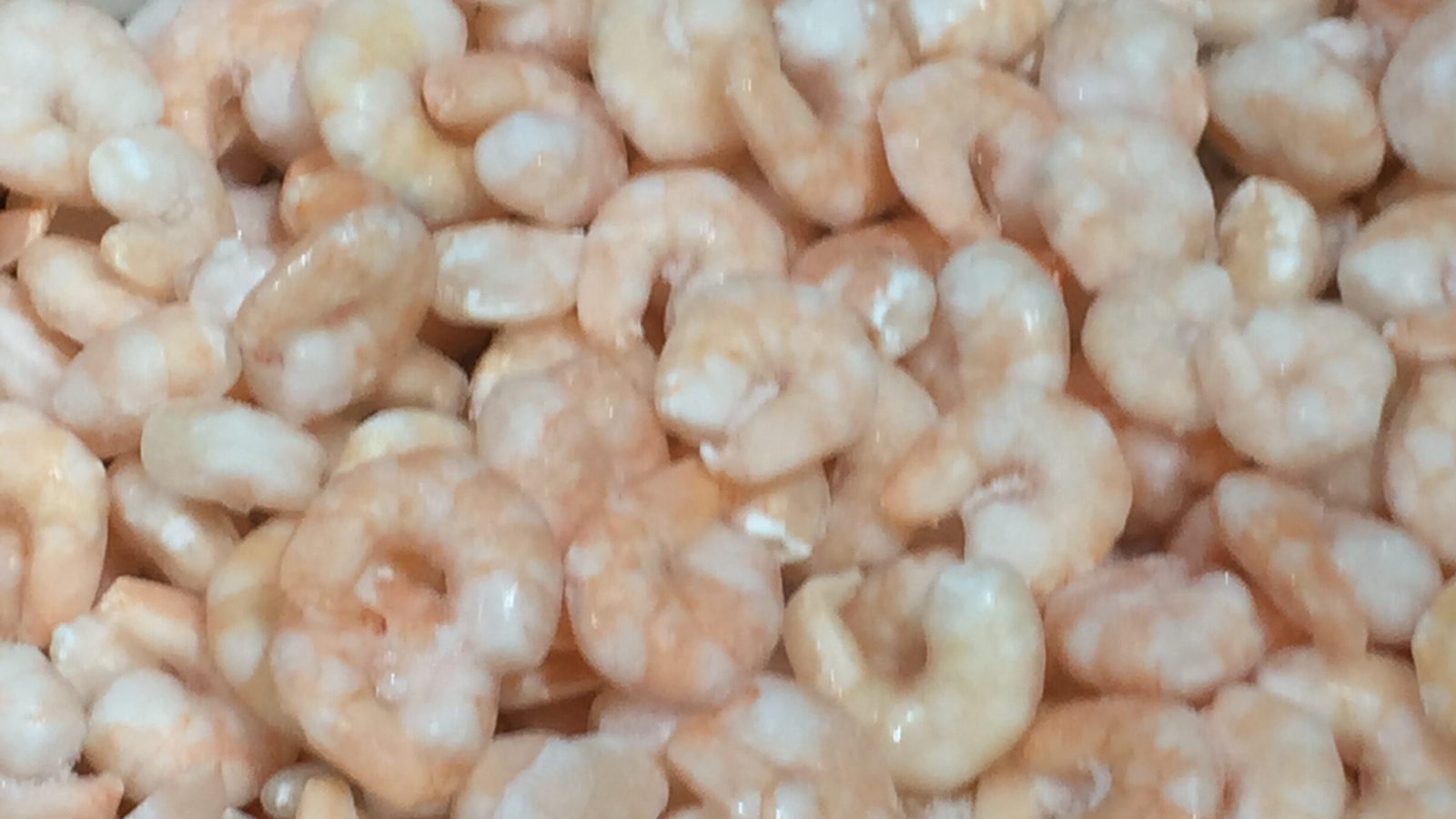
A specification is only worth what you can measure. Five steps, run on the first three lots and then quarterly:
- Sample. Pull at least three cartons per lot, from different positions in the container. Record carton weight and lot code before opening.
- Deglaze. Follow Codex §7.3.2: work from frozen, melt the surface ice under running water at room temperature, drain two minutes on a 2.8 mm sieve inclined at about 20°. Do not fully thaw. Fully thawed product loses its own water and overstates the glaze (Seafish, 2016).
- Weigh and calculate. Record glaze as a share of net weight, (glazed − net) ÷ net, and as a share of gross weight, (glazed − net) ÷ gross. They are different numbers; state which one your specification uses.
- Count. Count pieces on the de-glazed weight, then convert to count per pound. Compare with the declared range.
- Cook. Weigh a sub-sample before and after a standard cook. Record the loss. A glaze-compliant product with a 40% cook loss is still a cost problem.
A purchase-order clause that survives audit:
Net weight exclusive of glaze, determined per Codex CXS 92-1981 §7.3.2. Glaze not to exceed [x]% of gross weight. Count [y/z] per pound on de-glazed weight. Added water to be declared. Buyer may test any lot on arrival; a lot outside specification may be rejected at seller’s cost.
Fill in the bracketed numbers from your own pack and shelf-life requirement, not from a template. The 5-10% range in the Seafish guidance is a starting point for a conversation, not a universal limit.
Where this argument breaks
First, glaze exists for a reason, and a tight spec has a cost. Pushing a supplier to 2% glaze to win a price argument can produce a product that freezer-burns in your own cold chain, which is a larger loss than the one you avoided. The right level depends on packaging, piece size, surface area and expected storage (Seafish, 2016).
Second, sampling is noisy. Glaze varies within a lot, between cartons and with storage history, so a single carton proves very little. The FDA’s own finding (36% of a 28-sample set) is a surveillance result across imported frozen seafood, not a shrimp-specific rate and not a statement about any particular origin or supplier (U.S. Food and Drug Administration, 2025). Use it to justify a test, not to accuse a vendor.
Third, yield data does not transfer cleanly. The Torry figures come from cold-water species and older processing; warm-water farmed shrimp, different counts and different peeling methods will land elsewhere. Use a yield assumption to rank options, then replace it with your own measured number.
Ask for the basis
The cheapest way to lose money on shrimp is to compare two prices that are not measured the same way. The expensive way is to discover it after the container is in the freezer.
The same arithmetic runs through the landed cost before the glaze question even starts; we work through it in distributor margin versus direct import.
Before the next quote review, ask three questions of every supplier: Is this price per kilo net of glaze, and measured how? What is the glaze percentage, and on which base? What is the count on de-glazed weight? A supplier who can answer in one line is telling you something about their process. A supplier who cannot is telling you something too.
Ecosea Insights
Ecosea supplies frozen shrimp and seafood from Vietnam to retailers and brands in the EU and US. If you are rewriting a net-weight specification, our product development and specification support can share how our lots are measured and documented.
Talk to our teamMore sourcing guidesBook an innovation sessionReferences
- Codex Alimentarius Commission. (1981). Standard for quick frozen shrimps or prawns (CXS 92-1981, revised 1995). Food and Agriculture Organization of the United Nations; World Health Organization. https://www.fao.org/fao-who-codexalimentarius/
- European Parliament and Council of the European Union. (2011). Regulation (EU) No 1169/2011 on the provision of food information to consumers (Annex IX). Official Journal of the European Union, L 304, 18-63. https://eur-lex.europa.eu/eli/reg/2011/1169/oj
- Seafish. (2016). Glaze (FS94_07_16). https://www.seafish.org/
- Torry Research Station. (n.d.). Handling and processing shrimp (Torry Advisory Note No. 54). Food and Agriculture Organization of the United Nations. https://www.fao.org/4/x5931e/x5931e01.htm
- U.S. Department of Agriculture. (2020). Frozen wild shrimp purchase specification (FPPS, August 2020). Agricultural Marketing Service. https://www.ams.usda.gov/
- U.S. Food and Drug Administration. (2018). Guidance for industry: 1991 letter to seafood manufacturers regarding the fraudulent practice of including glaze (ice) as part of the weight of frozen seafood (Docket No. FDA-2020-D-1923). https://www.fda.gov/regulatory-information/search-fda-guidance-documents/guidance-industry-1991-letter-seafood-manufacturers-regarding-fraudulent-practice-including-glaze
- U.S. Food and Drug Administration. (2025, September 2). FDA releases results on economically motivated adulteration (short weighting) in seafood. https://www.fda.gov/food/hfp-constituent-updates/fda-releases-results-economically-motivated-adulteration-short-weighting-seafood