A seafood benchmark is a product you bought, cooked and measured — not a category you admire — so decide what is the price of entry, what you will beat and what you will leave alone.
What the evidence shows
Three sources were opened on 1 November 2026: the Codex guidelines for the sensory evaluation of fish and shellfish in laboratories (CAC/GL 31-1999), the Codex standard for breaded and battered fish (CXS 166-1989), and the frozen coated category of one Spanish retailer, which listed 31 products that day, 16 of them fish or seafood. The listing is one shelf on one day and is not sell-through. No benchmark was bought or cooked for this article and no sensory result is reported. The attribute sheet and the verdicts are Ecosea’s proposal; the targets belong to the brand.
Table of Contents
Hake is not a seafood benchmark
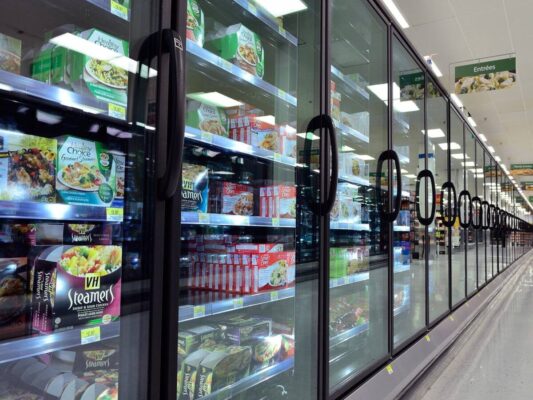
The brief said “match the leading breaded hake”. On 1 November 2026, one Spanish retailer’s frozen coated category listed 16 fish and seafood products, and hake appeared at least five ways: a fine-bread fillet, an egg-and-breadcrumb fillet, a “romana” stick, a finger and a shaped figure. One species, five products. They differ in coating, shape, count, cooking time and the occasion they are sold for.
So the first act of benchmarking is a purchase order for one named pack, in one pack size, from one retailer, on one date. Not a category review, and not a memory of a product. Buy two packs: one to examine frozen, one to cook. The sensory annex of CXS 166-1989 is blunt about why — the sample used for sensory evaluation should not be the same as the one used for the other examinations.
Cook it the way the pack says
CXS 166-1989 tells the examiner to cook the frozen sample according to the cooking instructions on the package; where none are given, or the equipment is not available, it falls back to a procedure based on heating the product to 65–70 °C internally. That is the principle to borrow: the benchmark’s method is the one on its pack, and your sample is cooked the same way, on the same day, in the same appliance.
Record the method as part of the result. Appliance and setting, preheat, number and spacing of pieces, shelf position, time, turn, hold, serving temperature. If the method changes between the two products, the difference you measure may be the oven. Cooking to a core temperature rather than only to the clock is the cheap control when piece sizes differ.
| Attribute | What to record | How, on the day | Why it carries the experience |
|---|---|---|---|
| Shape and size | Length, width, thickness, piece weight, count per pack | Ruler and scale on a run of pieces, still frozen | The first cue the shopper uses, and the attribute a standard can define |
| Coating coverage | Bare patches, ends, edges, cracks | Cut two pieces across and lengthwise; count and describe bare areas | Where the crumb fails first in the oven, and where the fish dries |
| Coating thickness and pickup | Coated weight against core weight; thickness at the centre | Weigh one piece, remove the coating, weigh the core | The ratio behind crunch, fish content and the price per kilogram |
| Adhesion and first bite | Crumb shed on the plate; where the coating separates; sound and force at first bite | Cut, lift, bite; collect what falls off | The attribute most often described, loosely, as quality |
| Fish texture | Flake, firmness, fibre, pastiness | Press with a fork, then bite; compare with the reference piece | Tells you whether the core survived freezing and the cooking method |
| Moisture | Juiciness, dryness, drip on the plate | Observe on cutting, then again after two minutes on the plate | Separates a thin product from a dry one, which is a different fault |
| Seasoning and aroma | Salt level, heat, aroma on opening the pack and the oven | Smell before tasting; taste core and crumb separately | The part a factory can change most cheaply, and the part shoppers notice first |
| Plate presence | Colour, gloss, spread, crumb scatter | Photograph the plate under the same light for both products | What is judged before the first bite, in a photograph or at the table |
Table stakes, differentiation and the line between them
Table stakes are the attributes the category or the standard defines, and the ones the shopper checks without thinking: a stick that looks like a stick, the fish content the pack declares, a cooking instruction that works from frozen, no bones where the pack says boneless. CXS 166-1989 is useful for the first of these because it fixes the shape: a fish stick including coating weighs between 20 g and 50 g, is at least 10 mm thick, and is at least three times as long as its greatest width. The shopper does not measure that. They see whether it looks right, and they are right often enough to matter.
Differentiation is the shorter list: the attributes that make the product worth its price. The first bite. The aroma when the oven door opens. Seasoning that survives the cooking method instead of washing off in it. Plate presence — what the product looks like on the plate before anyone tastes it.
Table stakes
The category defines it; the shopper checks it
- Shape, count and piece weight that look like the product they claim to be
- The fish content the pack declares, and the coating that comes with it
- A cooking method that works from frozen, in the appliance named on the pack
- No bones where the pack promises boneless
- A net weight and pack count that match the label
Differentiation
The brand can own it; the shopper can perceive it
- First-bite shatter, and crumb that stays on the piece
- Aroma when the pack or the oven opens
- Seasoning that survives the cooking method
- Plate presence: colour, gloss, spread
- A claim the pack can support without stretching
One verdict per attribute
Every attribute on the sheet gets one of four verdicts, written before the brief and changed only with evidence.
Keep means hold the benchmark’s level, because a drop would be noticed and nobody would pay for an improvement. Match means equal it, because it is the price of entry and a difference would only create an objection. Beat means exceed it — and only where you can measure the attribute, the factory can control it, and the shopper can perceive the difference. Differ means change it deliberately, with a reason the shopper can perceive and a claim the pack can support.
“Beat” is not a mood. It is a claim about three things at once: measurement, control and perception. If any of the three is missing, the verdict is Match, whether or not the room prefers your sample.
The defect that looked like a signature
The expensive mistake is not copying a competitor. It is copying a weakness because it looked like character.
Take a soft, pasty centre, a strong fishy or feed note, or a crumb that never browns. CAC/GL 31-1999 notes that a fishy aroma may or may not indicate decomposition depending on the species, and that gills can carry a leathery or slightly rancid odour after frozen storage with no significance for the quality of the product. CXS 166-1989, meanwhile, treats a persistent and distinct objectionable odour or flavour indicative of decomposition, rancidity or feed as a defect. The same note can be character in one product and a defect in another, and neither document can tell you which one you are holding.
So test the attribute before you adopt it. Buy a second pack, or a second batch, and see whether the note is consistent. Cook it two ways. Check whether the standard’s defect list names it. Then ask the only question that decides a verdict: can the factory hold this attribute deliberately, batch after batch? If it cannot, you have not found a signature. You have found something you will be explaining in a customer complaint later.
The purpose of a benchmark is not to produce a copy. It is to show you where the leader has chosen to spend, so you can separate the price of entry from the reason to buy — and then decide, attribute by attribute, which one you are buying. That decision is the brief. The benchmark brief is where it gets written down, and the sample scorecard is where it gets tested.
What this cannot tell you
One pack, one day, one market. The listing says what was on a shelf, not what sells. Nothing here measures consumer preference: a benchmark shows what exists, not what your shopper wants, and a product that matches it perfectly may still have no reason to be bought. Your verdicts are hypotheses until a factory can hold them in production, and the panel that tests them is a separate design — the subject of the sensory evaluation protocol.
What to do next
- Buy the benchmark, not the category. One named pack, one pack size, one date. Two packs: one for the frozen examination, one for the cooking.
- Write the method before the first cook. Appliance, setting, load, time, core temperature, hold. The same method for both products, on the same day.
- Give every attribute a verdict. Keep, match, beat or differ. A “beat” needs a measure, a control point and a shopper who can perceive it.
- Test the note you are about to copy. A second pack, a second cooking method, and the standard’s defect list. If the factory cannot hold it on purpose, it is not a signature.
A benchmark does not tell you what to make. It tells you what the shopper already accepts, which is the only honest starting point for deciding what to change.
Ecosea works on seafood product development for retailers and brands: benchmark definition, sample preparation and specification support. We do not sell competitor data, run consumer research or guarantee a listing.
Benchmark before the brief
Matching a product you did not make? Ecosea can buy the reference, cook both the same way and turn the attribute sheet into a brief a factory can answer.
References
- Codex Alimentarius Commission. (1999). Guidelines for the sensory evaluation of fish and shellfish in laboratories (CAC/GL 31-1999). FAO/WHO. https://www.fao.org/input/download/standards/359/CXG_031e.pdf
- Codex Alimentarius Commission. (1989). Standard for quick frozen fish sticks (fish fingers), fish portions and fish fillets — breaded or in batter (CXS 166-1989; revised 2004, amended 2014). FAO/WHO. https://www.fao.org/input/download/standards/112/CXS_166e_2014.pdf
- Mercadona. (2026). Congelados: Rebozados [Frozen coated products]. Retrieved November 1, 2026, from https://tienda.mercadona.es/categories/884