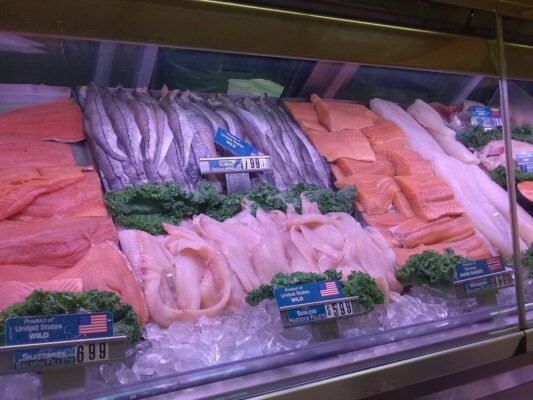
A range of 72 frozen seafood SKUs can still repeat one idea. A five-axis matrix shows the crowded cells, the empty ones, and which empty cells are empty for a reason.
What the evidence shows
Mercadona’s Spanish online store listed 72 frozen fish and shellfish SKUs on 1 November 2026: 36 fish, 20 shellfish and 16 breaded fish. Fourteen are hake; 13 are plain cephalopod preparations. No SKU in the sample is sold as a seasoned or sauced main. A listing records what is offered, not what sells, and one retailer on one day is a sample, not a market.
Table of Contents
A long range, one idea
Most range reviews begin with a count. Mercadona’s frozen fish and shellfish pages (Mercadona, 2026) carried 72 SKUs on 1 November 2026. Sixty-two carry the Hacendado own brand, seven carry a supplier brand and three carry no brand in the listing.
The count says the range is long. It does not say it is wide. Eight of the 36 fish SKUs are plain hake in different cuts: fillet, large fillet, portion, medallion, slice, headless, small hake and loin. Thirteen are plain cephalopods, almost all cleaned, sliced or whole, and unseasoned. Fourteen are plain crustaceans, raw or cooked, peeled or whole.
The shopper sees variety. The matrix sees one idea in eight cuts.
Five axes, one page
Build the map from the retailer’s own product data, not from memory. On one date, take every frozen SKU in the species group and record five things: species, format, preparation, the occasion the pack is designed for, and the price per kilogram on the declared net weight.
Then draw it. Species down the side. Preparation across the top: plain cut, plain whole or pieces, coated, seasoned or sauced, assembled. Put the count in each cell and the price band under the species name. A cell with eight SKUs, a cell with one and a cell with none are three different facts.
Two rules keep it honest. Count listings, never facings, and never treat a listing as a sale. Keep the unit constant: price per kilogram of declared net weight, not per pack, because the main packs in this sample run from 100 g to 1 kg and the shelf price hides the difference. The basis matters: Codex requires a glazed shrimp pack’s declared net contents to exclude the glaze (Codex Alimentarius Commission, 1981, §6.2), and EU guidance repeats the rule (European Commission, 2017, para. 16); a listing that gives only a pack price does not say which basis it used.
| Species · price band | Plain | Coated | Seasoned or sauced | Assembled |
|---|---|---|---|---|
| Hake€5.25-13.25/kg | 8crowdedfillet, portion, medallion, slice, loin, whole | 5crowdedcrumb, batter, egg wash | 0empty | 1presentcroquettes |
| Cod€18.33-24.00/kg | 4presentfillet, loin, portions, migas; all branded | 0empty | 0empty | 1presentcod balls |
| Salmon€15.80-23.80/kg | 3presentfillet, loin, medallion | 0empty | 0empty | 0empty |
| Tuna€13.75-17.50/kg | 2presentslices, cubes | 0empty | 0empty | 1presentempanadillas |
| Cephalopods€11.00-19.86/kg | 13crowdedrings, tubes, whole, pieces, roe | 3presentrings, rabas, floured | 0empty | 0empty |
| Crustaceans€9.92-34.25/kg | 14crowdedraw, cooked, peeled, whole | 2presentformed, battered | 0empty | 0empty |
| Shellfish€4.22-11.29/kg | 4presentmussel, clam, snail | 0empty | 0empty | 0empty |
| Surimi€4.17-8.00/kg | 1presentsticks | 0empty | 0empty | 2presentaritos, muslitos |
| Other fish€5.17-18.50/kg | 6crowdedpanga, emperor, shark, monkfish, mix | 1presenttempura | 0empty | 1presentpaella mix |
| All 72 SKUs | 55 | 11 | 0 | 6 |
Crowded where the attention went
The crowded cells are not a verdict on demand. They are a record of where the range has been extended. Plain hake has eight cuts, coated hake five, plain cephalopods 13 and plain crustaceans 14. The range grew by adding formats to species that already worked.
| SKU | Format and pack | €/kg | Brand |
|---|---|---|---|
| Hake fillet | Fillet, skinless, 600 g | 9.33 | Hacendado |
| Hake medallions | Medallion, 500 g | 9.00 | Hacendado |
| Hake slices | Slice, 600 g | 9.92 | Hacendado |
| Hake, large fillet | Fillet, skinless, 1 kg | 13.25 | Hacendado |
| Cod fillet | Fillet, 375 g | 19.73 | MareDeus |
| Salmon fillet | Fillet, skin on, 370 g | 16.50 | Hacendado |
| Langostino, cooked | Peeled, 220 g | 22.73 | Hacendado |
| Pota rings | Rings, 360 g | 15.97 | Hacendado |
The seasoned and sauced column is empty. Not one of the 72 SKUs is sold as a seasoned or sauced main; the only marinade is a 5% component inside a coated shrimp product. The nearest thing to a composed dish is a paella and soup mix.
Cod is empty in a more specific way. All four plain cod SKUs carry the MareDeus brand at €18.33-24.00/kg, with one declared recipe: 90% cod, 8% water, 2% salt. The own brand has no cod entry.
Salmon has three SKUs, all plain: a wild pink fillet, skinless loins and medallions. Only the medallions cook from frozen; the loins need 24 hours in a fridge first.
- 8Under €6/kgSurimi, empanadillas, palitos, clams; the entry tier.
- 20€6-10/kgThe most crowded band: plain hake, coated hake, mussels.
- 14€10-15/kgCalamari, squid, tuna cubes, emperor slices.
- 19€15-20/kgSalmon, plain rings, shrimp, cod portions.
- 11Above €20/kgLobster, langoustine, cod loin, peeled shrimp; the top tier.
An empty cell is a question
An empty cell can be empty for five reasons, and four are good.
Supply. A species may come through one branded supplier whose certification, scale or origin cannot be replicated quickly. That is one reading of the cod cell.
Shelf life. A sauce adds water, allergens and a second phase that can separate on freeze-thaw. A pack can fail a 12-month frozen shelf-life test before it fails a taste test.
Seasonality. A product built for a festive or religious occasion may not earn its facing for eleven months.
Demand. A seasoned fish may be a foodservice product that does not survive the move to a 220 g retail pack.
Price architecture. Every added lever moves the cost per kilogram and the price tier. A retailer that fills the cell at the wrong tier has not filled it.
The matrix does not say which reason applies. It says which question to ask, and who should answer: sourcing, technical or commercial.
Three hypotheses, three kill criteria
Turn the empty cells into statements a buyer can kill.
Hypothesis 1, the seasoned cell is demand, not shelf life. If a two-portion frozen salmon or hake with a glaze holds 12 months at −18°C and cooks from frozen in 20 minutes, it earns a place between the plain fillet and the assembled dish. Test it in ten stores for 12 weeks against the plain fillet in the same tier. Kill it if units per facing per week do not beat the plain fillet, or if the glaze fails shelf life at month nine.
Hypothesis 2, the cod cell is a brand premium, not a supply constraint. If a second supplier can hold the 90/8/2 recipe at the same net weight, an own-brand cod at €15-17/kg takes volume from the branded entry without shrinking the category. Test it with two factory quotes against the branded specification, then a price-band test. Kill it if no second supplier can hold the recipe, or if the branded SKU’s volume does not move when the own-brand enters.
Hypothesis 3, the coated range is built for the fryer. All ten coated SKUs that give a cooking method lead with a fryer or pan; one also gives oven instructions. If oven-only households are a real segment, an oven-first coated product fills an occasion rather than a species. Test it with a point-of-purchase survey, then a bake test at 200°C against the fryer control. Kill it if the oven version cannot match the fryer on crispness after 18 minutes.
Each hypothesis has a number that can fail it. That is the difference between a gap and a wish.
What to do next
The same matrix works on a competitor’s shelf: benchmarking another retailer’s range is the mirror exercise, same axes and different data. Once a cell survives, the work moves to the specification, where “coated” has to become a number, and then to development, where a factory must prove it can hold that number.
- Build the matrix for one species. Ten to fifteen SKUs is enough to see the pattern; the full category hides it.
- Write the reason beside every empty cell. Supply, shelf life, seasonality, demand or price. A blank reason is a blank brief.
- Take three hypotheses, not thirty. Each one carries its test and its kill criterion, so the buyer can say no early.
The next SKU should be a decision about a cell, not another cut of the same fish.
Ecosea builds range matrices from retailer and supplier data, tests the empty cells against supply and shelf life, and writes the brief only for the cells that survive. Bring one species and one market to a range review.
Range review
Bring one species and one market. Ecosea will map the range, separate the crowded cells from the empty ones, and turn the empty cells into tests your buyers can run.
References
- Codex Alimentarius Commission. (1981). Standard for quick frozen shrimps or prawns (CXS 92-1981, revised 1995, amended 2014). Food and Agriculture Organization of the United Nations; World Health Organization. https://www.fao.org/input/download/standards/107/CXS_092e.pdf
- European Commission. (2017, November 21). Commission Notice on the application of the principle of quantitative ingredients declaration (QUID) (2017/C 393/05). Official Journal of the European Union, C 393, 5-14. https://eur-lex.europa.eu/legal-content/EN/TXT/?uri=CELEX:52017XC1121(01)
- Mercadona. (2026). Congelados: Pescado; Marisco; Rebozados [Frozen fish, shellfish and breaded products]. Retrieved November 1, 2026, from https://tienda.mercadona.es/categories/149, https://tienda.mercadona.es/categories/150 and https://tienda.mercadona.es/categories/884