
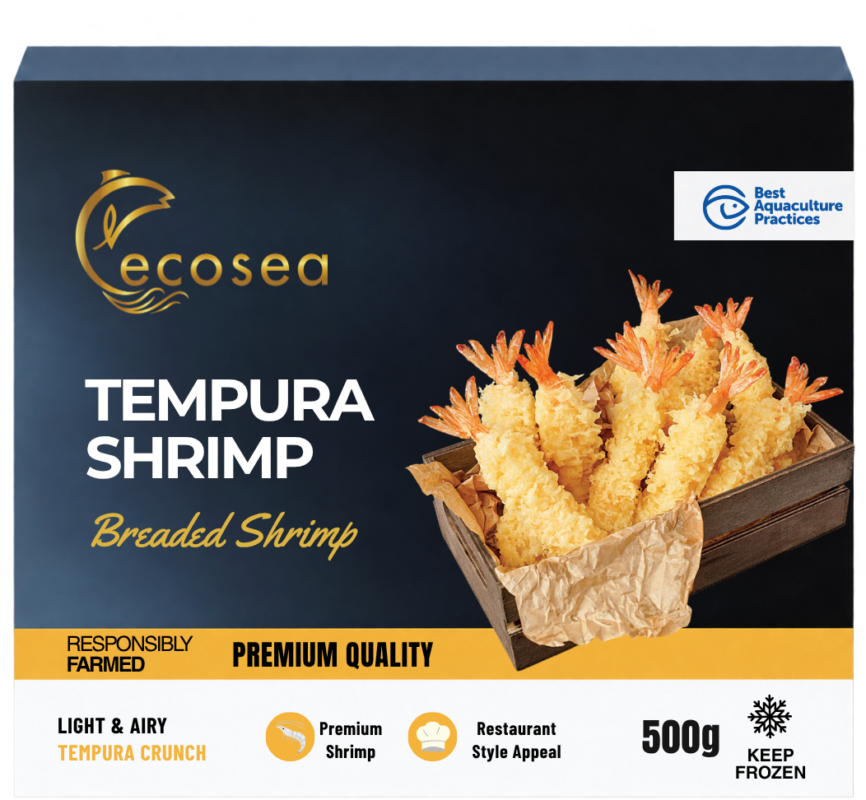
Tempura Shrimp
Give your frozen seafood range a proven, restaurant-style tempura shrimp without building it from zero. We match your benchmark — batter lightness, shrimp grade, pack format — then scale it to your private label.
Tell us about your market and product requirements.
Product overview
Whole tail-on shrimp in a light, airy tempura batter — IQF, cook-from-frozen. Appetiser, sharing plate, party food, rice/noodle topper. Value party packs up to premium tiger-prawn and club boxes.
Applications
- Retail frozen
- Foodservice
- Party & sharing
Product information
Reference data for the displayed configuration. Confirm the final specification for your market before launch.
- Species
- Vannamei
- Cut / grade
- Whole shrimp, tail-on (16–20 ct/lb most common)
- Batter system
- Light airy tempura batter (wheat flour + leavening)
- Dipping sauce
- Optional sweet soy / sweet chili
- Ingredients
- Shrimp, Water, Wheat flour, Soybean oil, Corn starch, Tapioca starch, Rice flour, Salt, Leavening (sodium acid pyrophosphate, sodium bicarbonate), Dextrose, Garlic powder, Onion powder, Sodium tripolyphosphate.
- Allergens
- Shrimp (crustacean), wheat; soy in sauce lines
- Basis
- per 100 g / per serving (116 g)
- Energy
- 240 kcal / 278 kcal
- Fat
- 12.4 g / 14.4 g
- of which saturates
- 2.1 g / 2.4 g
- of which trans
- 0.2 g / 0.2 g
- Cholesterol
- 70.6 mg / 81.9 mg
- Sodium
- 435.3 mg / 504.9 mg (22% DV per serving)
- Carbohydrate
- 20 g / 23.2 g
- of which fibre
- 0 g / 0 g
- of which sugars
- 1.2 g / 1.4 g
- Protein
- 10.6 g / 12.3 g
- Sodium · market requirement
- Final sodium target is set per destination market. For Canada and the US, the formulation is reviewed against the applicable front-of-pack and sodium-claim thresholds before launch.
- Cook target
- 165°F (74°C) internal
- Cooking
- Oven 400–450°F 10–18 min · air fry 400°F 8–9 min · deep fry 350°F 3.5–4 min
Packaging, storage temperature and shelf life are confirmed per the agreed specification.
Options & variations
Indicative configurations for this product line. Pack format, shrimp count, coating, treatment and preparation can be specified to your brief — not every combination is standard, so confirm availability before the first sample.
| Pack format |
|
|---|---|
| Shrimp count (per lb) |
|
| Cut / shape |
|
| Coating / batter |
|
| Treatment |
|
| Sauce / seasoning |
|
| Preparation |
|
Start a sample brief
Share your benchmark, launch window, target cost and intended channel to frame the next evaluation.
Discuss your development brief ↗For product development teams
The development opportunity
An evidence-based view of why this format exists, where it sells, and what to develop. Product-line counts come from Ecosea's own market scan; market figures are from public sources, linked below.
Market rationaleWhy this format?
Tempura shrimp is a proven, widely ranged format rather than a niche item. A scan of 12 anonymised retail and food-service listings across four English-language markets - the USA (5), the UK (4), Canada (2) and Australia (1) - shows every major frozen-seafood aisle already carries a tempura/battered shrimp line. Pack economics scale from party 10- and 12-count, 156 g-16 oz trays up to 30-count club/family packs and a 500 g food-service pack (31-40 ct/lb), and roughly half the listings bundle a soy, sweet-soy or similar dipping sauce. In the UK, post-COVID retail volume growth has come largely from frozen coated products, and prepared/coated seafood has held its place as a quick, low-average-price meal solution. In Canada, prepared/packaged seafood is where shoppers have been trading, with seafood-preparation volumes up 16.9% in 2024.
Where it playsChannel and occasion
Listings place tempura shrimp in three overlapping occasions: entertaining (party packs), quick weeknight meal or kid-friendly protein (oven-bake or air-fryer, cook from frozen), and snacking/meal component (about 4-5 shrimp per serving with included dipping sauce). Channel-wise the evidence is overwhelmingly retail frozen (11 of 12), with one B2B/food-service bulk pack, so the natural primary channel is retail frozen with a food-service-pack secondary SKU.
Product propositionWhat to differentiate?
Air-fryer-first convenience: make air-fryer timing and a crisp-from-frozen result a headline claim, since air-fryer/oven 'cook from frozen' is already the dominant preparation instruction. Sauce and flavour bundling: about half the scanned SKUs include a dipping sauce, so a differentiated included sauce or bold flavour variant is a low-cost way to stand out. Certified responsible sourcing and traceability: flagship listings already carry ASC or BAP certification; a verifiable ASC/BAP plus clean-label coating turns a commodity battered item into a trust-led premium offer.
References
Have an annual development brief?
Share your benchmark, launch window, target cost and intended channel to frame the next evaluation.
Related products
View all products ↗Bring this concept into your development pipeline.
Discuss formats, flavours and market requirements with our team.