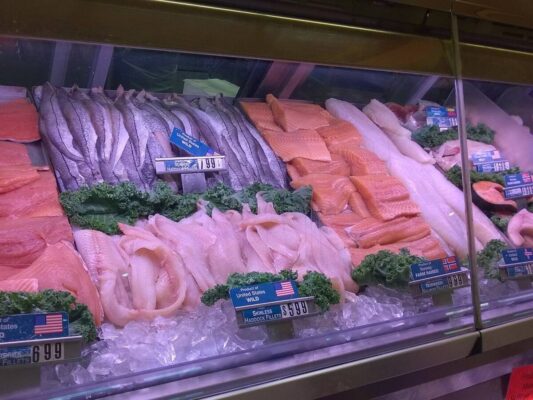
A retailer buying direct inherits four decisions the importer used to make: the approved sample, the site audit, the signed deviation and the rejected container. Tesco’s own account of its audit model shows the shape of that work. It does not show what the work costs.
What the evidence shows
Tesco’s written answers to the Irish government describe an audit regime the retailer runs itself, sites in high-risk countries audited before supply and then annually, with auditing extending past the first tier where product risk requires it. The duty behind direct buying is set out in 21 CFR 123.12, which lets an importer hire a third party to do the verification work but not to hold the file. Neither source discloses a defect rate, a rejection rate or a cost. The four-decision map below is Ecosea’s framework, not a finding from either source.
Table of Contents

The importer was never only a middleman
The importer’s invoice buys freight, credit and judgement, and the judgement is the part that is hardest to replace. Someone decided that this sample, not that one, was the standard for the season. Someone walked the plant and decided it could hit that standard again in March. Someone signed the paper that let a short-weight or off-colour lot ship. Someone decided whether a refused container was a negotiation or a loss.
Those four decisions do not disappear when the purchase order goes to the factory. They move to whoever now holds the specification, and in most first-year direct programmes nobody has been appointed to hold it. The result is not a cheaper programme. It is a programme with four unowned decisions and a claim that arrives before an answer does.
Importer, before the purchase order moves
Direct buyer, after
What the rule actually puts on the importer
For fish and fishery products, the operative duty at the border is not the Foreign Supplier Verification Programs rule. FSVP expressly does not apply to fish and fishery products that are subject to, and in compliance with, FDA’s seafood HACCP regulation (U.S. Food and Drug Administration, 2026). The obligation sits in 21 CFR 123.12 instead, and it is written in the language of the four decisions.
An importer must hold written verification procedures that list “product specifications” designed to ensure the product is not adulterated, and must take affirmative steps that may include obtaining the processor’s HACCP and sanitation records for the specific lot, a lot-by-lot certificate, regular inspection of the processor’s facilities, an English copy of the HACCP plan with a written guarantee, or periodic testing (21 C.F.R. § 123.12). Records must be kept in English. Where those assurances do not exist, “the product will appear to be adulterated and will be denied entry.”
Two provisions carry the rest of the argument. An importer “may hire a competent third party to assist with or perform any or all of the verification activities”, but the records obligation and the entry decision stay with the importer (21 C.F.R. § 123.12(b)-(c)). Delegation is available. Accountability is not.
What Tesco says it does
The Department of Foreign Affairs and Trade in Ireland published a case study of Tesco plc in May 2020, updated in May 2023, built from written answers the company supplied (Department of Foreign Affairs and Trade, 2020). It is self-reported: Tesco wrote the answers and no independent assessment is attached. It describes an ethical-trade audit regime, not a product-quality one, and that distinction matters to a seafood buyer.
On method the answer is specific. Tesco says its ethical auditing is focused mainly on the first tier of the supply chain, the sites that produce the final product, a food manufacturing plant among them. “Sites in high risk countries must have an audit before supply and then on an annual basis.” Depth then follows product risk: Tesco says it audits “down to grower level” for fresh fruit and vegetables, working with first-tier suppliers who cascade the requirement upstream.
The regime is staffed rather than announced. A Group Responsible Sourcing Director leads it, reporting to the Group Quality Director and Chief Product Officer. The board’s Corporate Responsibility Committee monitors progress three times a year. Tesco describes 45 responsible sourcing specialists across nine key sourcing countries.
Three limits belong in the same breath. The page discloses no defect rate, no rejection rate and no cost of running the regime. It covers labour standards, so it tells you who inspects a site and how often, not what happens to a shrimp lot that fails a weight check. And Tesco names the ceiling itself, in a sentence a buyer should read as a warning about any audit file, including one built for quality.
“We recognise that in many cases we cannot address labour rights abuses without first addressing the root causes which underlie them, ethical auditing alone often does not address root causes.”
- Before supplyAn audit, in high-risk countriesTesco says sites in high-risk countries must be audited before they supply, not after a problem.
- AnnuallyThe same sites, audited againThe requirement is a repeating obligation with a frequency, not a one-off gate.
- Beyond first tierDown to grower level, where the product requires itTesco says it audits upstream for fresh fruit and vegetables, with first-tier suppliers cascading the requirement.
- Three times a yearBoard committee reviewProgress is monitored by the board’s Corporate Responsibility Committee, per Tesco’s answer.
- Not disclosedDefect rate, rejection rate or costThe published answers describe the regime and its staffing, and report no quality or cost outcome.
What transfers is the shape, not the result. A retailer that owns the audit layer needs a risk tier, a frequency, a named owner, a travel budget and a route past the first tier when risk sits upstream. What does not transfer is the idea that a site audit answers a question about one lot.
Why the inspection at the end is too late
A destination check feels like the safeguard: the container arrives, someone opens it, someone looks. FDA’s guidance on scombrotoxin-forming fish explains why that is a screen rather than a control. Decomposition odours typical of low-temperature abuse “may not be present if the fish has undergone high temperature spoilage”, which makes sensory examination alone “an ineffective control”. The sampling needed to accommodate uneven distribution “is necessarily quite large”, not fewer than 18 samples per lot (U.S. Food and Drug Administration, 2022).
The hazard in that passage is histamine in finfish, not shrimp, and carrying the point across is Ecosea’s inference rather than the source’s claim. The principle is not species-specific: a check on a sample estimates a lot, and it cannot un-sell what is already on a shelf. By the time a defect is visible at your distribution centre, the only remaining decisions are commercial, and the shelf has already been planned around product you cannot use.
That is the order in which the four decisions have to be settled. The sample fixes what “conforming” means. The audit fixes whether the site can hit it repeatedly. The deviation fixes who may accept a miss, and on what terms. The rejection clause fixes who funds the loss. Three are decided before a container is booked; the fourth by whoever wrote the contract.
The importer’s version
A technical team that already expects to travel
- A named technologist signs the sample and owns the retained copy.
- Audit visits are booked, scoped and closed as part of the year.
- The claim is absorbed in the margin across several origins.
- A refusal is offset against future volume with the same factory.
- The file exists before the question is asked.
The failure mode after direct
A buyer with a specification and no route
- Nobody has been named as the signatory for a deviation.
- No travel line exists for a plant visit this year.
- The claim is settled against one shipment, not a portfolio.
- A refusal is an argument with a factory that owes nothing else.
- The file is assembled after the container is refused.
Design the route before the first purchase order
Three things, in this order.
- Name a signatory for each decision, not a department. The sample, the audit, the deviation and the rejection each need one person whose name appears. A supplier who cannot name your signatory will route the request to whoever says yes.
- Put the sample in the contract, not in an email. The approved sample is a standard only if it is versioned, retained on both sides and referenced in the purchase specification. An unversioned sample is a photograph of a good day.
- Write the rejection clause before the first shipment. 21 CFR 123.12 stops at denial of entry; it does not allocate the freight, the cold storage or the disposal. Whoever holds title at the point of refusal carries those costs unless the contract says otherwise, so the clause belongs in the first purchase order, not in the argument after the first claim.
Direct buying is not a decision about whether quality control happens. It is a decision about who inspects, who signs and who pays. A buyer who cannot name those three people has not removed the risk. They have moved it to someone who cannot see it.
What this does not show No defect rate, rejection rate, inspection cost or saving is printed here, because neither the Tesco answers nor the FDA sources disclose one for a comparable category. The Tesco case is an ethical-trade audit model, not a seafood quality regime, and it is used for the shape of the ownership, not for an outcome. The four-decision map is Ecosea’s framework: it organises obligations that exist in 21 CFR 123.12 and gaps that the rule leaves open. It is not a legal conclusion about any party’s liability.
Before the first container
Designing the quality route? Ecosea can help define the specification, qualify the factory and hold a sample against it, so the first purchase order has a standard attached to it.
References
- Department of Foreign Affairs and Trade. (2020, May 11). Case study: Tesco Plc. Government of Ireland. https://www.gov.ie/en/department-of-foreign-affairs/publications/case-study-tesco-plc/
- Special requirements for imported products, 21 C.F.R. § 123.12 (2026). https://www.ecfr.gov/current/title-21/chapter-I/subchapter-B/part-123/subpart-C/section-123.12
- U.S. Food and Drug Administration. (2022). Fish and fishery products hazards and controls guidance (June 2022 ed.). https://www.fda.gov/food/seafood-guidance-documents-regulatory-information/fish-and-fishery-products-hazards-and-controls-guidance
- U.S. Food and Drug Administration. (2026, May 1). FSMA final rule on Foreign Supplier Verification Programs (FSVP) for importers of food for humans and animals. https://www.fda.gov/food/food-safety-modernization-act-fsma/fsma-final-rule-foreign-supplier-verification-programs-fsvp-importers-food-humans-and-animals