A second source buys recovery; consolidation buys price and control. The decision belongs at line level, where the cost of a stock-out can be estimated.
What the evidence shows
Walmart’s sourcing page documents a network with teams in 22 countries buying more than 400,000 private-brand SKUs from over 4,000 suppliers, alongside origin-level goals for the United States and India. It shows a large retailer running concentration and diversification at the same time; it does not disclose a category-level dual-sourcing rule, a recovery measure or the cost of qualifying a second factory.
Table of Contents
The short answer
Neither policy survives contact with a real range. A retailer that consolidates everything is betting that none of its remaining factories will fail during the contract. A retailer that diversifies everything is paying qualification costs on lines where a failure would barely register on the shelf.
The workable answer is a portfolio: concentrate volume where the specification can be replaced quickly and a stock-out is cheap; keep a qualified second source where a failure would empty a shelf or break a private-label promise. The unit of decision is the line, not the supplier base.
What consolidation buys before a second source
Three things.
The first is scale. Volume concentrated in one factory is the usual argument for price, but it also buys scheduling priority and willingness to tool a line. A factory that runs one retailer’s specification every week learns it.
The second is quality management. Fewer sites mean fewer audits, fewer corrective-action loops and a shorter list of suppliers to verify. Under the US Foreign Supplier Verification Programs rule, the importer must verify that each foreign supplier meets applicable FDA safety standards (U.S. Food and Drug Administration, n.d.). A short supplier list makes that programme tractable rather than theoretical.
The third is specification control. One glaze level, one cook regime, one net-weight distribution and one packing format are easier to hold across one site than five, and drift is easier to detect against a single reference.
None of this is an argument for a single source. It is an argument for concentrating where the consequences of failure are containable.
What diversification buys
The first is time.
A factory can stop supplying for reasons that are easy to list: fire, flood, a failed audit, a labour dispute, a disease event in the source fishery or farm, a port closure, a change in ownership. What decides the damage is not the lead time on a purchase order but the recovery time: how long it takes to replace the volume with product that meets the same specification. A second source that has never been qualified does not shorten that clock. It restarts it.
The second is origin risk. Trade measures, seasonal closures and catch restrictions apply to places, not to suppliers, and a factory in a restricted origin cannot ship its way around them. The catch is that origins are not interchangeable. Two shrimp origins may differ in size distribution, colour, glaze behaviour and texture, so a second source is only real if the specification is written at the level that matters and a sample has been run against it.
The third is innovation. A new product usually comes from a supplier with spare capacity and a reason to win the business; Walmart’s sourcing page lists pilots with newer companies on carbon-to-textile, 3D weaving and crop forecasting.
What diversification does not buy is a lower price. A second source costs qualification: sample rounds against the specification, shelf-life and yield trials, an audit and its corrective actions, a verification file, and for shrimp the harvest-to-entry data that the Seafood Import Monitoring Program requires (NOAA Fisheries, 2025). It also costs the small orders that keep the source warm. The bill is paid once and then maintained; the price premium is what you pay if you never qualify anyone.
What Walmart’s sourcing page documents
Walmart International Sourcing describes a network with teams in 22 countries buying more than 400,000 private-brand SKUs from over 4,000 suppliers (Walmart, n.d.). The company’s own description of the purpose is explicit: it helps “develop and grow suppliers, allowing us to have a robust network that insulates our supply chain from potential disruption or unforeseen changes.”
The same page sets origin-level goals. In FY2023, two-thirds of Walmart U.S. product spend was on items made, grown or assembled in the United States, and the company aims to source $350 billion in U.S. products by the end of 2031. In December 2020 it committed to $10 billion a year in exports from India by 2027, from about $3 billion at the time (Walmart, 2020).
That is concentration and diversification at once: many countries and thousands of suppliers, with deliberate weight in two origins. What the page does not disclose is what a buyer needs. There is no category-level rule for when a second factory is required, no measure of recovery time and no figure for what qualifying a second source costs. It is the company’s own account — a description of a portfolio and a set of targets, not a result. The page covers private-brand products across categories, including general merchandise, and gives no seafood category outcome.
The criticality test
Four questions, asked line by line.
| Test | The question to ask | Points to concentration | Points to a second source |
|---|---|---|---|
| Share of sales | Does the line bring customers in, or fill a slot? | The line is one of many; a gap is not noticed. | The line is a destination and its absence is visible. |
| Substitutability | Can another factory make the same specification without a new trial? | A qualified alternative already exists. | Only this factory has run the specification. |
| Lead time | How long to replace lost volume, not just to ship it? | Replacement fits inside the cover you hold. | Replacement takes longer than your stock. |
| Shelf life | How much time does the product give you to react? | Long code life allows a buffer. | Short code life removes the buffer. |
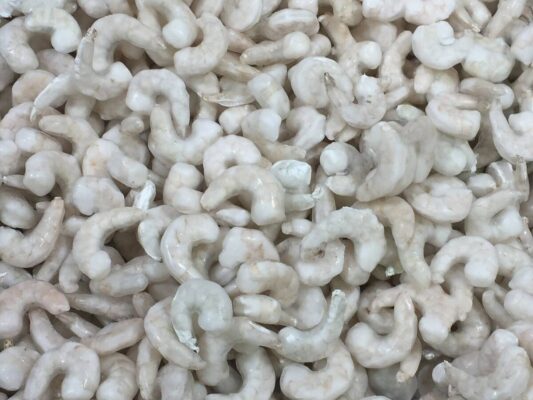
The test is not a scorecard but a way to stop a portfolio average from deciding a line. A shrimp range usually contains both kinds of line: a core cooked, peeled tail-on shrimp in a standard count that carries footfall and a seasonal value-added item that fills a slot. Treating them the same is how a programme ends up either over-insured or exposed.
The grid follows from the same answers. High substitutability and a cheap failure: concentrate, review annually. High substitutability and an expensive failure: qualify a second source now, because the switch is possible but the interruption still hurts. Low substitutability and an expensive failure: dual-source and hold cover — the line where one factory is a single point of failure with no fast exit. Low substitutability and a cheap failure: concentrate and accept the risk.

What this does not show Walmart’s page describes a private-brand network across categories, including general merchandise. It does not give supplier counts by category, a dual-sourcing rule, recovery performance or the cost of qualification, and its scale does not transfer to a mid-sized retailer. No seafood-specific conclusion should be drawn from it.
What to do next
- Rank lines by the cost of a stock-out, not by spend. The biggest-spend line is not always the most critical one. Ask what the shelf looks like for a month if the factory stops.
- Write the specification so a second factory can be qualified against it. Species, count, glaze, net weight, treatment and packing, stated tightly enough that a sample can be judged. A second source cannot meet a specification that exists only in the incumbent’s process.
- Budget qualification as a fixed cost, with a date. Samples, trials, audit and verification file, then a small recurring order that keeps the source alive. A qualified factory with no orders is a name on a list, not a source.
The right number of factories is not a company policy. It is a line-level answer that changes with volume, origin risk and shelf life — and the retailers that get it right can say, for each line, what a failure would cost and how quickly they could recover.
Before the second factory
Weighing a second source? Ecosea can help write the specification, qualify the factory and run the sample against it — so the alternative is a qualified source, not a name on a list.
References
- NOAA Fisheries. (2025, May 30). Seafood Import Monitoring Program. https://www.fisheries.noaa.gov/international/international-affairs/seafood-import-monitoring-program
- U.S. Food and Drug Administration. (n.d.). FSMA final rule on Foreign Supplier Verification Programs (FSVP) for importers of food for humans and animals. Retrieved November 1, 2026, from https://www.fda.gov/food/food-safety-modernization-act-fsma/fsma-final-rule-foreign-supplier-verification-programs-fsvp-importers-food-humans-and-animals
- Walmart. (n.d.). Walmart International sourcing. Retrieved November 1, 2026, from https://corporate.walmart.com/about/international/about/sourcing
- Walmart. (2020, December 10). Walmart commits to sourcing $10 billion of India-made goods each year by 2027 [Press release]. https://corporate.walmart.com/news/2020/12/10/walmart-commits-to-sourcing-10-billion-of-india-made-goods-each-year-by-2027