
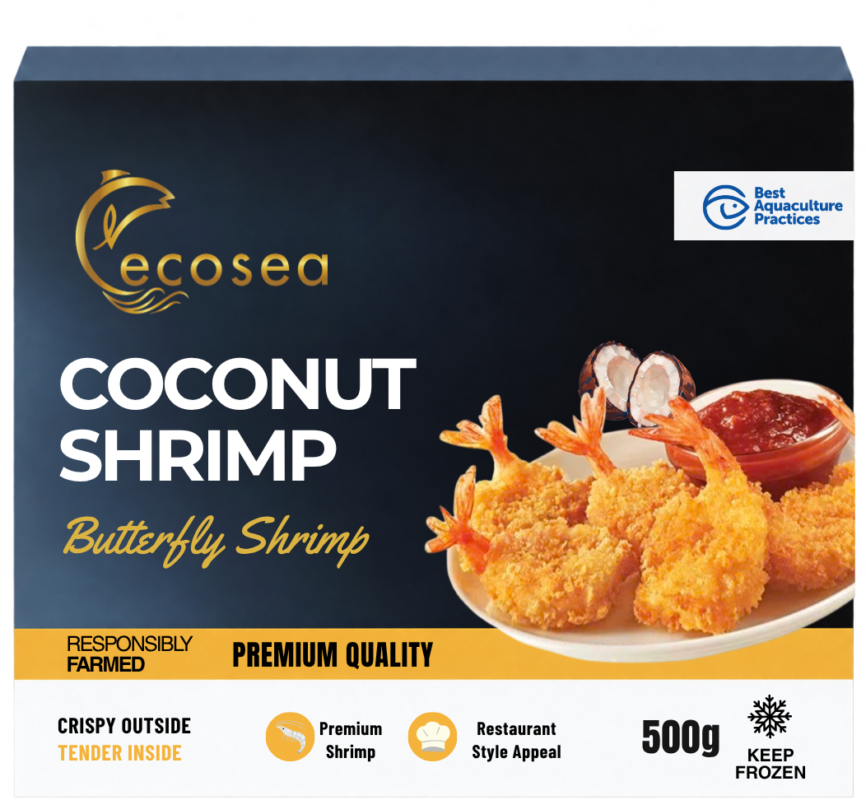
Coconut Shrimp
Coconut shrimp is a high-margin, tropical differentiator. We develop it to your coconut crumb, dip and pack — a premium line you can own.
Tell us about your market and product requirements.
Product overview
Butterfly shrimp in sweet coconut-flake breading, IQF. Appetiser or tropical side, almost always with a sweet dip. Party packs to family boxes, with sweet-chili or marmalade dips.
Applications
- Retail frozen
- Foodservice
- Party & sharing
Product information
Reference data for the displayed configuration. Confirm the final specification for your market before launch.
- Species
- Vannamei
- Cut
- Butterfly, tail-on (torpedo-cut on foodservice)
- Coating system
- Coconut-flake breadcrumb; panko & coconut option
- Dipping sauce
- Sweet chili or orange marmalade
- Seafood share
- ~40–50% (some ~44%) — tunable
- Ingredients
- Shrimp, Wheat flour, Water, Coconut (flakes, milk, milk powder), Vegetable oil, Modified corn starch, Sugar, Yellow corn flour, Salt, Yeast, Leavening (sodium acid pyrophosphate, baking soda), Whey, Paprika & annatto extract, Sodium phosphate, Sulphiting agents.
- Allergens
- Shrimp (crustacean), wheat, coconut; milk and soy in some
- Basis
- per 100 g / per serving (85 g)
- Energy
- 247 kcal / 210 kcal
- Fat
- 12.7 g / 10.8 g
- of which saturates
- 4.9 g / 4.2 g
- of which trans
- 0 g / 0 g
- Cholesterol
- 64.7 mg / 55 mg
- Sodium
- 517.6 mg / 440 mg (19% DV per serving)
- Carbohydrate
- 26.3 g / 22.4 g
- of which fibre
- 2.4 g / 2 g
- of which sugars
- 6 g / 5.1 g
- Protein
- 8.2 g / 7 g
- Vitamin D
- 0 mcg / 0 mcg
- Calcium
- 64.9 mg / 55.2 mg
- Iron
- 0.7 mg / 0.6 mg
- Potassium
- 130.5 mg / 110.9 mg
- Sodium · market requirement
- Final sodium target is set per destination market. For Canada and the US, the formulation is reviewed against the applicable front-of-pack and sodium-claim thresholds before launch.
- Cook target
- 145–165°F (63–74°C)
- Cooking
- Oven 400–450°F 12–17 min · air fry 350–400°F 7–10 min · deep fry 350°F 2.5–3.5 min
Packaging, storage temperature and shelf life are confirmed per the agreed specification.
Options & variations
Indicative configurations for this product line. Pack format, shrimp count, coating, treatment and preparation can be specified to your brief — not every combination is standard, so confirm availability before the first sample.
| Pack format |
|
|---|---|
| Shrimp count (per lb) |
|
| Cut / shape |
|
| Coating / batter |
|
| Treatment |
|
| Sauce / seasoning |
|
| Preparation |
|
Start a sample brief
Share your benchmark, launch window, target cost and intended channel to frame the next evaluation.
Discuss your development brief ↗For product development teams
The development opportunity
An evidence-based view of why this format exists, where it sells, and what to develop. Product-line counts come from Ecosea's own market scan; market figures are from public sources, linked below.
Market rationaleWhy this format?
Coconut shrimp combines the plate presence of a butterflied shrimp with the crunch and sweet-savoury appeal of a coated appetizer. The butterfly cut gives a wide, even surface for coconut flake adhesion and a generous look on the plate, while the coating performs in the oven or air fryer. Shrimp is a core import category in the U.S. - 1.7 billion pounds were imported in 2023, and shrimp represented 26% of the value of U.S. edible seafood imports - so coconut breading adds a distinct point of difference inside an already high-volume category.
Where it playsChannel and occasion
Primarily retail frozen seafood and appetizer sets in the U.S. and Canada, with 8-10 oz and 1.5 lb packs and 255-315 g Canadian packs. Sauce-included kits (sweet chili or marmalade) suit party and appetizer occasions; sauce-free and bulk packs suit foodservice, delis and prepared-meal operators. The format also works beyond the starter occasion - tacos, po'boys, salads and rice bowls.
Product propositionWhat to differentiate?
Sugar, sodium and label story are the first lever: retail packs show a wide spread in added sugar and sodium, so a coconut shrimp that keeps the sweet-savoury profile with lower added sugar and sodium, and a short, real-coconut-forward label, can stand apart. Second, crunch that survives the oven: panko-plus-coconut or coarse-flake systems, strong adhesion and reliable cook-from-frozen performance (about 7-17 minutes). Third, pack architecture: clear count and grammage, sauce-in versus sauce-out options, and matched retail/foodservice specifications.
References
Have an annual development brief?
Share your benchmark, launch window, target cost and intended channel to frame the next evaluation.
Related products
View all products ↗Bring this concept into your development pipeline.
Discuss formats, flavours and market requirements with our team.