Lemon Harissa Shrimp
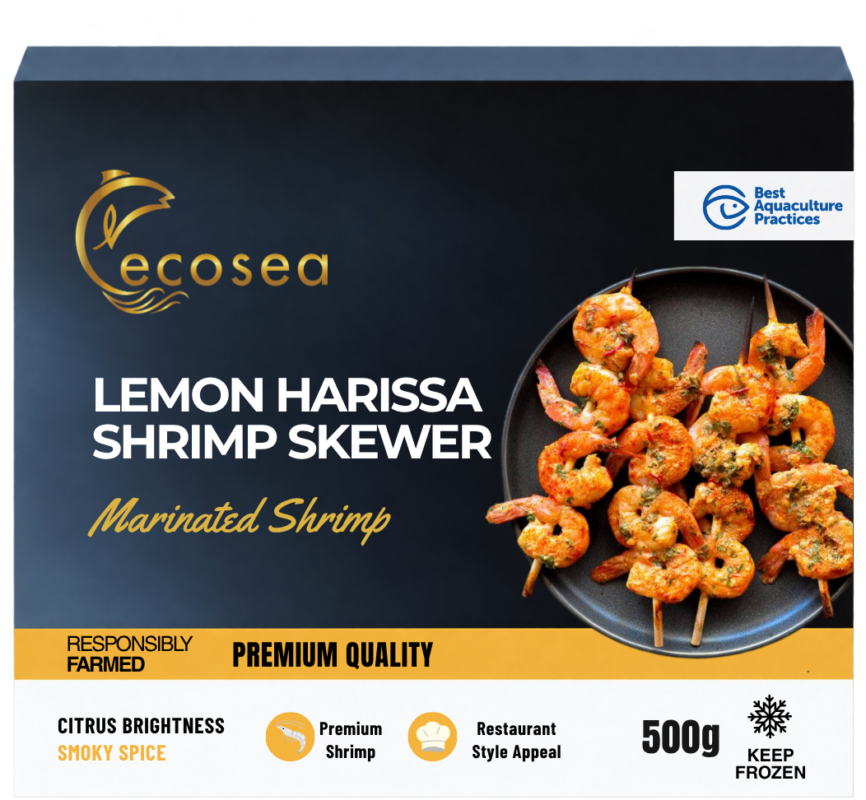
Lemon harissa is a modern, on-trend flavour that differentiates a range. We develop the harissa heat and lemon balance to your brand.
Tell us about your market and product requirements.
Product overview
Shrimp in a harissa-style sauce with honey and lemon. Entrée over couscous, rice or flatbread. Retail sauce pack (10 oz).
Applications
- Retail frozen
- Ready to cook
- Foodservice
Product information
Reference data for the displayed configuration. Confirm the final specification for your market before launch.
- Species
- Vannamei
- Shrimp
- Sauce-packed (not breaded)
- Sauce
- Harissa-style: chili and spices balanced with honey and lemon
- Format
- Cook from frozen per the pack
- Ingredients
- Shrimp, Harissa-style sauce (chilli, spices, honey, lemon), Vegetable oil, Salt.
- Allergens
- Shrimp (crustacean)
- Basis
- per 100 g / per serving (140 g, about 10 shrimp)
- Energy
- 236 kcal / 330 kcal
- Fat
- 17.9 g / 25 g
- of which saturates
- 9.3 g / 13 g
- Carbohydrate
- 8.6 g / 12 g
- of which fibre
- 0.7 g / 1 g
- of which sugars
- 2.1 g / 3 g
- Protein
- 7.9 g / 11 g
- Sodium
- 529 mg / 740 mg
- Sodium targets
- Set per destination market. For sodium-sensitive markets such as Canada and the US, the formulation is reviewed against the applicable front-of-pack and sodium-claim thresholds before launch.
- Cooking
- Per pack, from frozen · Per pack, from frozen
Packaging, storage temperature and shelf life are confirmed per the agreed specification.
Options & variations
Indicative configurations for this product line. Pack format, shrimp count, coating, treatment and preparation can be specified to your brief — not every combination is standard, so confirm availability before the first sample.
| Pack format |
|
|---|---|
| Shrimp count (per lb) |
|
| Treatment |
|
| Sauce / seasoning |
|
| Preparation |
|
Start a sample brief
Share your benchmark, launch window, target cost and intended channel to frame the next evaluation.
Discuss your development brief ↗For product development teams
The development opportunity
An evidence-based view of why this format exists, where it sells, and what to develop. Product-line counts come from Ecosea's own market scan; market figures are from public sources, linked below.
Market rationaleWhy this format?
Lemon-harissa sits in a thin part of an otherwise crowded set: locally there are six scampi SKUs and six herb-and-garlic shrimp SKUs, but only one lemon-harissa SKU. That makes it a line extension rather than a new category - it can trade on the frozen, cook-from-frozen shrimp habit already established at retail. Frozen carried 36% of UK retail seafood volume in 2023, and fresh-plus-frozen reached almost 80% of U.S. seafood consumption by 2021.
Where it playsChannel and occasion
Anchor in U.S. and Canadian grocery frozen seafood sets, merchandised beside scampi and garlic shrimp rather than in a separate international set; a 10 oz (283 g) dinner-for-two pack matches the existing local anchor. Secondary: UK/EU multiple-retail frozen prawn fixtures, where warm-water prawns were a top-five species by volume in 2023.
Product propositionWhat to differentiate?
Heat architecture: state and grade the heat (e.g. mild/medium) and balance it with lemon and a little sweetness so it reads flavour-first, not novelty heat. Sauce performance: a thick, clinging harissa glaze that cooks from frozen in one pan or on a tray without a watery purge - execution is the real differentiator here. Provenance and label: certified sustainable shrimp (BAP/ASC where available) and a short ingredient deck; with about 80% of U.S. seafood imported, origin and certification are visible trust cues.
References
Have an annual development brief?
Share your benchmark, launch window, target cost and intended channel to frame the next evaluation.
Related products
View all products ↗Bring this concept into your development pipeline.
Discuss formats, flavours and market requirements with our team.