A seafood business case is not a forecast with a cover page. It is a short list of claims, each marked as evidence or assumption, each with an owner, a date and a condition that stops the project.
What the evidence shows
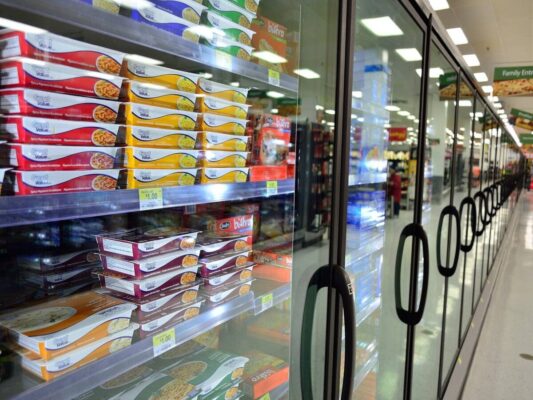
Twenty frozen seafood products were read on Mercadona’s category and product pages in Spain on 1 November 2026, alongside the Codex labelling standard (CXS 1-1985) and the quick-frozen shrimp standard (CXS 92-1981). Two cooked and peeled prawn packs sat in a €4.75–€5.00 band at 200–220 g. That is a price and format observation, not evidence of demand. No sales, cost, margin or shopper data was available, and none is inferred.
Table of Contents
The seafood business case that does not name an occasion
On 1 November 2026, Mercadona in Spain listed two cooked and peeled prawn packs: 200 g at €4.75 and 220 g at €5.00. Both named the format. Neither named an occasion. That is a price band and a pack format, not a gap. The gap is a hypothesis, and a hypothesis is what a one-page case has to test — not what it may assume.
The approver is deciding whether the next spend is justified, not whether the product is good.
A useful case has five parts: shopper, product, commercial frame, risk and decision rule. Each has evidence, assumption, owner and date; if a line cannot be filled, the case is not ready.
- Shopper caseWhat is missing, for whom, at which occasion. Evidence first; the assumption named.
- Product caseWhat it is, what it replaces, and the difference a panel can test.
- Commercial framePrice position, cost range and space, each with a source.
- Risk columnSeasonality, supply and cannibalisation, each with a stop condition.
- Decision ruleWhat is being approved, what would change it, and who signs.
The shopper case and the product case
The shopper case says what is missing, for whom, at which occasion. It needs a dated observation more than the other columns.
In the prawn example, the evidence is narrow: two cooked and peeled packs, 200–220 g, €4.75–€5.00, read on one day. The assumption is that a two-portion lunch pack is underserved. The evidence does not prove that assumption. It gives the case a price band and a format to test against, which is more than a blank page and less than a finding.
Write the assumption in the shopper’s words, not the brand’s. “A shopper who wants a quick lunch for two has to buy a 220 g pack built for a different occasion” is testable. “Shoppers want convenience” is not.
The product case has to name what it replaces
A new product is a replacement. It replaces a pack the shopper already buys, a format they already accept or a decision they already make. The product case should name that thing. The SKU’s role is a separate decision (role of a new seafood SKU).
It should also state the difference in a form a panel can test: species, format, piece size, coating or glaze, cooking method, pack count. If the difference is only “a better eating experience”, the case has no product case yet. It has a hope.
The Codex labelling standard is useful here: the label has to indicate the true nature of the food and must not mislead (Codex Alimentarius Commission, 1985, §3.1 and §4.1). If the case cannot describe the difference in words that would survive that test, the pack will not be able to say it either.
The commercial frame is a range, not a point
The commercial frame has three lines: price position, cost range and space. One is observed, one is quoted, one is agreed.
For the prawn example, the price position is the observed band. The cost range is not yet known; two factories should quote the same specification, in the same pack, on the same Incoterm, before the case goes to an approver. The space is a separate conversation with the category buyer, written as a condition, not an afterthought. The target price has its own discipline (develop to a target retail price).
Do not put a payback period, a return on investment, a margin target or a sales uplift on the page. Those are forecasts, and they invite the approver to argue with the arithmetic instead of the evidence. If you show arithmetic, label it illustrative and print every assumption beside it. A price per kilo is a measurement: pack price divided by declared net weight, with glaze excluded (Codex Alimentarius Commission, 1981). A payback number is a forecast wearing a measurement’s clothes.
Approve a test
A defined next step
- A sample against a named benchmark.
- A period, store set and success condition.
- A stop condition and a named reader.
- Spend limited to the sample and trial.
Approve a listing
A distribution commitment
- Evidence of repeat, not just trial.
- Supply at volume and a second source.
- Artwork approved and space agreed.
- A cost that holds at volume.
The risk column is where the case earns trust
Three risks belong on the page: seasonality, supply and cannibalisation. Each gets an owner, a date and a stop condition.
Seasonality. Does the raw material exist in the volume and grade the case needs, in the weeks the launch needs it? The answer is a calendar, not an average.
Supply. Is there a second source, a second line or a second origin? A case that depends on one line is not automatically wrong. It is a case that has to say so.
Cannibalisation. Name the existing SKU the new one is most likely to take volume from. If the case cannot name it, the case has not looked at the range. If it can, the test has to measure the named SKU as well as the new one.
Write the risk as a condition, not an adjective: “one line, one origin, no approved second source” is a risk; “supply is tight” is not.
The stop condition is part of the case
A case without a stop condition asks permission to keep going. Write the condition before the first sample: what result would make you stop, who reads it, and what happens to stock and tooling.
Good stop conditions are specific enough that two people reading the same result would decide the same way. “If the panel cannot tell the new product from the 220 g reference in a blind test, stop.” “If two quotes both miss the observed price band at the declared pack, stop.” “If no second source can be approved before the launch window, stop or narrow the launch.” None of these needs a forecast. Each one changes what happens next.
| Claim | Evidence — source, date, owner | Assumption — owner, date to confirm | Stop if |
|---|---|---|---|
| Two cooked and peeled packs are priced at €4.75–€5.00 for 200–220 g | Retailer product pages, read 1 Nov 2026; category manager | — | The page or pack changes before sign-off. |
| A two-portion lunch pack is underserved | — | Category manager; confirm by 15 Nov 2026 | The occasion cannot be named in the shopper’s words. |
| The product is distinguishable from the 220 g reference | — | NPD lead; confirm by 30 Nov 2026 | A blind panel cannot tell the samples apart. |
| Two quotes can meet the observed price band | — | Procurement; confirm by 30 Nov 2026 | Both quotes miss the band at the declared pack. |
| A second source can be approved before launch | — | Supply and quality; confirm by 15 Dec 2026 | No second source is approved; narrow or stop the launch. |
| The new pack will not take volume from the named 220 g SKU without a category gain | — | Category manager; read after the test | The named SKU falls without a category gain. |
What this case cannot tell you
It cannot tell you whether the shopper will buy the product, whether the retailer will list it, whether the cost will hold at volume or whether a competitor will respond. Those are results of a test, not contents of a case. The case can only make the next spend auditable.
Sample: one retailer, one day. Two packs in a price band do not show a gap, a trend or a willingness to pay. The case should say that in the shopper column, not hide it in an appendix.
What to do next
- Write the decision requested at the top. A test, a listing or a stop. If the page asks for a listing, it needs evidence of repeat, supply at volume and agreed space — not a hypothesis.
- Mark every line evidence or assumption. Give each assumption an owner and a date. An assumption without a date is an opinion with a font.
- Put the stop condition on the page before the first sample. Say who reads the result and what happens to the stock if the answer is stop.
- Remove payback, return on investment, margin and sales uplift. Replace them with the measurement that would change the decision. If no measurement would, the case is not a case.
An approver cannot approve a product they cannot see. They can approve a test with a stated stop condition. That is the case worth writing.
Ecosea supports seafood concept and sample preparation, specification development and factory coordination. We do not forecast sales, guarantee listings or provide investment analysis; the commercial case remains the brand’s.
Before the next approval
Testing a new seafood product? Ecosea can help define the specification, prepare the sample and coordinate the factory — so the case starts from a real product.
References
- Codex Alimentarius Commission. (1981). Standard for quick frozen shrimps or prawns (CXS 92-1981; revised 1995, amended 2014). FAO/WHO. https://www.fao.org/input/download/standards/107/CXS_092e.pdf
- Codex Alimentarius Commission. (1985). General standard for the labelling of prepackaged foods (CXS 1-1985; amended 2010). FAO/WHO. https://www.fao.org/input/download/standards/32/CXS_001e.pdf
- Mercadona. (2026). Seafood [Frozen category]. Retrieved November 1, 2026, from https://tienda.mercadona.es/categories/150
- Mercadona. (2026). Deep frozen cooked and peeled cold water prawn Royal Greenland [Product page]. Retrieved November 1, 2026, from https://tienda.mercadona.es/product/24267/camaron-boreal-cocido-pelado-royal-greenland-ultracongelado-paquete
- Mercadona. (2026). Deep frozen king prawn cooked and peeled Hacendado [Product page]. Retrieved November 1, 2026, from https://tienda.mercadona.es/product/24477/langostino-cocido-pelado-hacendado-ultracongelado-bandeja