A seafood price premium is a difference the shopper can verify before purchase. If the only visible change is the number, the tier is a claim, not a product.
What the evidence shows
Twenty frozen seafood products were read on Mercadona’s category and product pages in Spain on 1 November 2026, alongside the Codex standard for quick-frozen shrimp (CXS 92-1981). Six prawn packs were compared on pack, price, drained weight, origin field and species statement. The pages show what the retailer published that day, not sales, willingness to pay or shopper preference.
Table of Contents
The seafood price premium a shopper can see
On 1 November 2026, Mercadona in Spain listed two 220 g trays of peeled king prawn from the same supplier. Both product pages named the same species in the legal description, Langostino vannamei. One tray was raw at €3.95; one was cooked at €5.00. Per kilo of declared weight, the cooked tray was 26.6 per cent more.
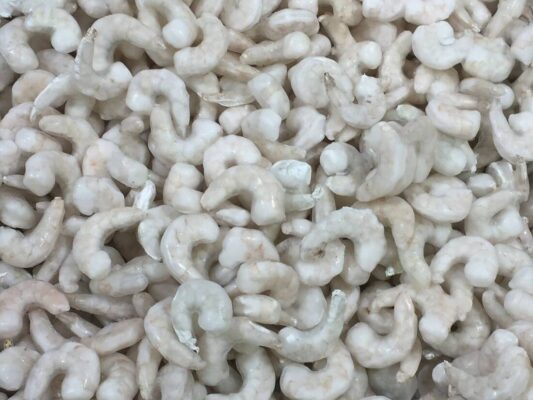
That is Ecosea arithmetic from two shelf prices, not a market premium: both packs declare 220 g, and the calculation uses the published price per kilo. It is also the kind of difference a shopper can see without reading a claim: the cooked prawn is pink, peeled and ready to eat. The raw one is grey and needs cooking. The extra money buys a different job, not a better adjective.
The question is not whether a brand can charge more. It is whether the shopper can find the reason before the first bite.
| Pack | Format | Price | Drained weight | Species and origin |
|---|---|---|---|---|
| Whole raw king prawn, 600 g | Whole, raw | €5.95 (€9.92/kg) | 600 g | Vannamei in legal name; origin not stated |
| Raw peeled king prawn, 220 g | Peeled, raw | €3.95 (€17.95/kg) | 220 g | Vannamei in legal name; origin not stated |
| Cooked peeled king prawn, 220 g | Peeled, cooked | €5.00 (€22.73/kg) | 220 g | Vannamei in legal name; origin not stated |
| Peeled large shrimp, 360 g | Peeled, raw | €5.95 (€16.53/kg) | 360 g | Solenocera melantho in legal name; origin not stated |
| Cooked peeled cold-water prawn, 200 g | Peeled, cooked | €4.75 (€23.75/kg) | Not declared | Common name only; origin not stated |
| Raw shrimp tails, 250 g | Tails, raw | €6.15 (€24.60/kg) | Not declared | Pleoticus muelleri in legal name; origin España |
The five levers that survive scrutiny
Raw material grade and origin. A named species, a size or count grade, a declared origin and a documented supply chain are things a shopper can check — if they are printed. “Premium prawn” is not. A grade is only a premium when the pack states the grade and the price reflects a difference the shopper can weigh.
Format and handling. Whole, headless, peeled, tail-on, cooked, raw, glazed, IQF. These change what the shopper has to do, how long it takes and what ends up on the plate. They are visible on the pack and in the product. This is the most honest lever in the list. Glaze is part of the format, not the fish: the Codex standard requires the declared net contents to exclude it (Codex Alimentarius Commission, 1981).
Eating experience. Texture, sweetness, salt level, coating adhesion, aroma. A shopper can verify these only by cooking and eating. A pack can describe them; it cannot prove them. If the case rests here, the case needs a blind test, not a new adjective.
Provenance you can document. A certificate, a vessel name, a catch area, a chain-of-custody code. The document has to resolve to something the shopper or the buyer can check. A logo that resolves to a membership page is weaker than a batch code that resolves to a named source.
Pack that explains it. A pack can make a difference legible: a cut name, a count, a drained weight, a cooking method, a reason to choose. It cannot create a difference that is not in the product. A new pack with a higher price is a price rise with better typography.
| Lever | Shopper can verify | Remains a claim | What belongs in the case |
|---|---|---|---|
| Raw material grade and origin | Species, grade, count, declared origin, document that resolves. | “Premium”, “selected”, an origin with no document. | The grade and origin stated on the pack, with the document behind it. |
| Format and handling | Whole or peeled, cooked or raw, tail-on, glaze, IQF. | “Restaurant style”, “chef selected”. | The job the format does and the time it saves. |
| Eating experience | Only by cooking and eating; a blind panel can compare. | Texture, sweetness and aroma before purchase. | A blind test against the named reference. |
| Documented provenance | A code, certificate or named source that resolves. | A logo that leads to a membership page. | The document, the batch and who checks it. |
| Pack that explains it | Cut, count, drained weight, cooking method, occasion. | A new pack with a higher price and no new difference. | The one difference the pack must make legible. |
The 26.6 per cent is not the premium
The cooked tray costs more per kilo than the raw tray. That is a fact about two prices on one day. It is not evidence that shoppers will pay it, that the premium is fair, or that the cooked product is better.
Premium cases can start with the price difference and work backwards. A brand adds a new pack, raises the price and calls the difference a premium. The shopper sees a higher number and the same product.
A demonstrable premium has three parts: a difference in the product, a way for the shopper to see it before purchase, and a reason the difference matters for the occasion. Remove any one and the tier becomes a claim. The cooked prawn passes the first two: the format is different and the pack says cooked and peeled. Whether it matters depends on the occasion, which is why the case needs a named occasion, not a demographic.
Claim versus proof
Asserted premium
A higher price with a new pack
- “Premium”, “selected”, “restaurant quality”.
- An origin with no document behind it.
- A new pack and a higher shelf price.
- A difference only the brand can explain.
Demonstrable premium
A difference the shopper can check
- A named species, grade and origin on the pack.
- A format that changes the job: cooked, peeled, tail-on.
- A document or code that resolves.
- A blind test against the named reference.
The left column is cheap to write and expensive to defend. The right column is slower to build and easier to keep. A pack that says “premium” without a named difference asks for trust; a pack that says “cooked and peeled, 220 g, vannamei” gives the shopper something to compare.
The same rule applies to origin. One page in the sample declared an origin of España, while its legal name gave a species name, Pleoticus muelleri. That does not prove the origin is wrong; it shows that the origin field alone does not tell a shopper whether it means catch, processing or packing. If origin is the premium, the document behind it has to be specific enough to answer that question.
What the pack can and cannot do
Packaging can carry a difference, but it cannot substitute for one. The detailed test belongs to a separate article on packaging that explains the product. The tier question is narrower: is the difference visible, and is it the difference the price is charging for?
A tier also has to survive the range review. If the premium rung is only a higher price on the same specification, the next cost review will flatten it. The discipline of building a ladder where each rung moves on a visible dimension is covered in good, better, best price tiers. This article is about the single step: what makes the shopper pay more for the same species.
What this cannot tell you It cannot tell you willingness to pay, sales, repeat purchase, sensory preference or whether the cooked product tastes better. The sample is one retailer, one market, one day, read online. It does not show the physical pack, the glaze, the piece count or the origin document. The price difference is arithmetic from two shelf prices, not a market benchmark.
A premium also depends on the alternative. The same 26.6 per cent may be invisible in one range and decisive in another. That comparison needs the shopper’s consideration set, which a retailer page does not show.
What to do next
- Put the two packs side by side and write the difference in one sentence, without adjectives. If the sentence needs “premium”, “selected” or “quality” to work, there is no difference yet.
- Check that the difference is on the pack, not only in the brand deck. A shopper cannot verify a claim that lives in a presentation.
- If the difference is origin or grade, make the document resolve. A code, a certificate or a named source the buyer can check. If it cannot be checked, it is a claim.
- If the difference is eating quality, run a blind test against the reference. If the panel cannot tell the difference, the premium is not demonstrable. Drop the tier or keep the price.
A premium is a promise the shopper can audit. The pack is where the audit starts.
Ecosea supports seafood specification, sample preparation and factory coordination. If you are building a premium tier, we can help test whether the difference is in the product and whether the pack can state it without overclaiming.
Before the premium tier
Building a trade-up? Ecosea can help test whether the difference is in the product — and whether the pack can state it without overclaiming.
References
- Codex Alimentarius Commission. (1981). Standard for quick frozen shrimps or prawns (CXS 92-1981; revised 1995, amended 2014). FAO/WHO. https://www.fao.org/input/download/standards/107/CXS_092e.pdf
- Mercadona. (2026). Seafood [Frozen category]. Retrieved November 1, 2026, from https://tienda.mercadona.es/categories/150
- Mercadona. (2026). Deep-Frozen King Prawn [Product page]. Retrieved November 1, 2026, from https://tienda.mercadona.es/product/24712/langostino-crudo-ultracongelado-caja
- Mercadona. (2026). Deep Frozen king prawn raw peeled Hacendado [Product page]. Retrieved November 1, 2026, from https://tienda.mercadona.es/product/24486/langostino-crudo-pelado-hacendado-ultracongelado-bandeja
- Mercadona. (2026). Deep Frozen king prawn cooked and peeled Hacendado [Product page]. Retrieved November 1, 2026, from https://tienda.mercadona.es/product/24477/langostino-cocido-pelado-hacendado-ultracongelado-bandeja
- Mercadona. (2026). Deep frozen peeled large shrimp Hacendado [Product page]. Retrieved November 1, 2026, from https://tienda.mercadona.es/product/24230/gamba-pelada-cruda-tamano-grande-hacendado-ultracongelada-paquete
- Mercadona. (2026). Deep frozen cooked and peeled cold water prawn Royal Greenland [Product page]. Retrieved November 1, 2026, from https://tienda.mercadona.es/product/24267/camaron-boreal-cocido-pelado-royal-greenland-ultracongelado-paquete
- Mercadona. (2026). Frozen raw shrimp tails Hacendado [Product page]. Retrieved November 1, 2026, from https://tienda.mercadona.es/product/24102/colas-gambon-crudo-hacendado-congelado-bandeja