A below-target SKU invites seafood reformulation. The cheaper explanation is distribution, price position or a pack that never explained the product — and each has a different fix.
What the evidence shows
Seven Cape hake products were read on Mercadona’s frozen fish category in Spain and on their product pages on 1 November 2026, alongside the Codex labelling standard (CXS 1-1985) and the Codex code of practice for fish and fishery products (CXC 52-2003). The sample shows names, declared weights and shelf prices. It does not show sales, facings, stock depth or why any product performed as it did. A listing is not sell-through.
Table of Contents
The seafood reformulation that arrives too early
A SKU misses its rate-of-sale target for a quarter. The first proposal is a recipe change: more fish, a new crumb, a different glaze. It is the most expensive answer available, and it is the one that leaves the original cause untouched.
You cannot see rate of sale on a shelf. You can see the conditions that make a rate of sale possible. Start there.
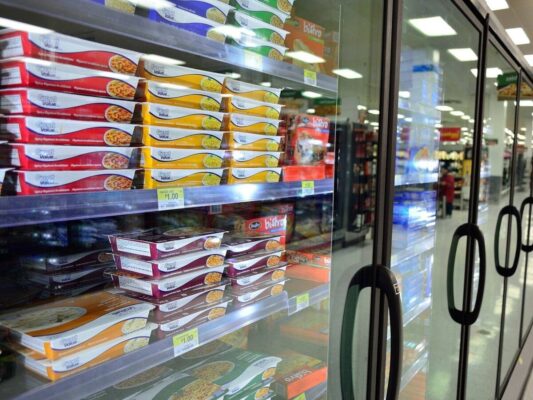
On 1 November 2026, the frozen fish category of Mercadona in Spain listed seven Cape hake products. All seven were listed; none carried an unavailable flag. Their shelf prices ran from €5.25 to €13.25 a kilo. The names described seven cuts: headless whole, headless, portions without skin, loins and centres, skinless fillets, medallions and steaks. Six of the seven declared a drained weight. The seventh, the loins and centres, did not.
That is not evidence that any product underperformed. It is evidence that the shelf can be checked before the recipe is touched, and that a price-per-kilo spread can be a cut spread rather than a quality spread. One page, one day, one retailer. The sample does not show sales, facings or stock depth.
Check the shelf before the recipe
Five checks, in order. Each has a different owner and a different cost.
Is it on shelf and in stock? A listing is not availability. A product that is out of stock for a third of the quarter is not being rejected; it is not being seen. Pull store-level availability, out-of-stock days and facings before you touch the product.
Is the price position right for its tier? Compare price per kilo of declared fish, not pack price. A pack can be cheaper because it contains less. The Codex code of practice for fish and fishery products says the proportion of glaze should be recorded and used to determine net weight, which excludes the glaze (FAO & WHO, 2020). If the price per kilo is out of line with the tier, the fix is price or pack, not a new recipe.
Does the pack explain the product? The label name has to indicate the true nature of the food and must not mislead (Codex Alimentarius Commission, 1985, §3.1 and §4.1). On the hake shelf, “portions”, “loins and centres” and “medallions” are three words a shopper cannot rank without a cut definition. If the pack does not say what the cut is, the shopper cannot tell what the extra money buys. The pack test is set out in packaging that explains the product.
Is the occasion clear? Read the pack copy, the cooking instruction and the portion count together. If the pack serves no named occasion, the shopper has to invent one. That is a copy and format problem before it is a product problem.
Is the product itself the issue? Only now. Buy the benchmark, cook both the same way, code the samples and use the same panel. If the product fails that test, reformulate. If it passes, the recipe is not the cause.
| Cut on the pack | Pack | Price | €/kg | Drained weight | Origin field |
|---|---|---|---|---|---|
| Headless whole | 1 kg | €5.25 | 5.25 | 1.0 kg | Namibia |
| Headless | 700 g | €5.77 | 8.25 | 700 g | España |
| Portions, skinless | 500 g | €4.90 | 9.80 | 500 g | España |
| Loins and centres | 400 g | €4.90 | 12.25 | Not declared | Namibia |
| Skinless fillets, large | 1 kg | €13.25 | 13.25 | 1.0 kg | Not stated |
| Medallions | 500 g | €4.50 | 9.00 | 500 g | Not stated |
| Steaks | 600 g | €5.95 | 9.92 | 600 g | Not stated |
The diagnosis order
The order is not a suggestion. It is a cost sequence. Availability and price are cheap to check and cheap to fix. A pack change costs artwork, a print run and a new approval; a reformulation costs a sample, a trial slot, a specification revision and a new artwork round. Move to the expensive check only when the cheap ones are clear.
There is a second reason for the order. Each check produces a different kind of evidence. Availability produces a count of days. Price produces a unit comparison. Pack produces a reading of the label. Product produces a sensory result. Mixing them lets a strong opinion in one column overrule a weak fact in another.
- 01On shelf, in stockStore-level availability, out-of-stock days, facings.
- 02Price positionPrice per kilo of declared fish against the tier.
- 03Pack explainsCut, count, drained weight, cooking method.
- 04OccasionWho buys it, for which meal, in what portion.
- 05Blind cooking testSame benchmark, same method, coded samples.
What each signal allows you to change
The table is deliberately conservative. A repeated out-of-stock does not prove the product is weak, and a low price per kilo does not prove it is strong. Each signal only licenses the next check.
| Signal | First action | What not to do | Cost of the wrong order |
|---|---|---|---|
| Repeated out-of-stock | Fix supply, space or replenishment. | Reformulate a product nobody can buy. | A trial slot and artwork reset that leave the cause untouched. |
| Price per kilo out of line | Reposition the price or resize the pack. | Change the recipe to justify the price. | A specification change that does not close the gap. |
| Pack name or copy unclear | Rewrite the name, cut and weight. | Add a premium cue to a pack that does not explain. | A new label on the same confusion. |
| Occasion unclear | Change the portion, pack or cooking cue. | Blame the product for a pack that serves no meal. | A product that works and a pack that does not. |
| Product fails a blind test | Reformulate against the benchmark. | Change the price first. | A price cut that teaches the shopper to wait for promotion. |
| All checks clear, target missed | Review the role, the target or the range. | Keep reformulating to avoid a delist decision. | A fixable product removed, or a dead SKU kept alive. |
The uncomfortable case is the SKU that clears every check and still misses its target. Then the product may be in the wrong range, or the target may be wrong, or the shopper may have a better alternative that the range review has not noticed. Delisting is a legitimate decision. It should be made on the same evidence as the others, not as a punishment for a number nobody has diagnosed. The signal hierarchy that should change the next brief is covered in after-launch signals.
A reformulation resets the specification, the sample, the artwork and the approval record. If the cause was availability, none of that touches the cause. If the cause was a pack that never explained the cut, the new product may repeat the same mistake with a new label.
What this sample cannot tell you Seven products on one retailer’s page on one day is not a category audit. The sample does not show rate of sale, repeat purchase, basket context, facings, stock depth, margin or promotion history. It does not show whether any of these products underperformed. It shows that a shelf can be read for the first two checks, and that a pack can be read for the third, without asking a factory to change anything.
The Codex texts describe labelling and net-weight principles. They do not audit a plant, approve a product or decide a commercial case. Confirm labelling and net-weight questions with your own labelling adviser and your importer.
What to do next
- Pull store-level availability before the next range review. Count out-of-stock days, not just the listing. A product that is missing is not a product that was rejected.
- Rebuild the price per kilo on declared fish. Use the net weight, not the pack weight, and treat glaze separately. Compare like cuts, not like prices.
- Read the pack name aloud to someone who does not buy the category. If they cannot tell you what cut they are getting, the pack is doing less work than the price.
- Book the blind cooking test only after the first three checks pass. Same benchmark, same method, coded samples, one panel. If the product passes, do not reformulate it.
The cheapest fix is the one you can see from the shelf. Take it before you take the recipe apart.
Ecosea supports seafood specification, factory qualification, sampling and quality execution. If a line is below target, we can help separate the distribution, pack and product questions before a reformulation is commissioned.
Before the next range review
Reviewing a line that missed its number? Ecosea can help separate the distribution, pack and product questions before a reformulation is commissioned.
References
- FAO & WHO. (2020). Code of practice for fish and fishery products (CXC 52-2003). https://openknowledge.fao.org/3/cb0658en/cb0658en.pdf
- Codex Alimentarius Commission. (1985). General standard for the labelling of prepackaged foods (CXS 1-1985; amended 2010). FAO/WHO. https://www.fao.org/input/download/standards/32/CXS_001e.pdf
- Mercadona. (2026). Fish [Frozen category]. Retrieved November 1, 2026, from https://tienda.mercadona.es/categories/149
- Mercadona. (2026). Headless whole hake deep frozen Mascato [Product page]. Retrieved November 1, 2026, from https://tienda.mercadona.es/product/62176/pescadilla-merluza-sin-cabeza-hacendado-ultracongelada-paquete
- Mercadona. (2026). Deep-frozen headless of Cape hake Hacendado [Product page]. Retrieved November 1, 2026, from https://tienda.mercadona.es/product/24324/merluza-cabo-sin-cabeza-hacendado-ultracongelada-pieza
- Mercadona. (2026). Deep-frozen portions of cape hake without skin Hacendado [Product page]. Retrieved November 1, 2026, from https://tienda.mercadona.es/product/62103/porciones-merluza-cabo-sin-piel-hacendado-ultracongeladas-paquete
- Mercadona. (2026). Deep-frozen hake loins and centres of Cape Hacendado [Product page]. Retrieved November 1, 2026, from https://tienda.mercadona.es/product/62113/lomos-centros-merluza-cabo-hacendado-ultracongelados-caja
- Mercadona. (2026). Deep-frozen skinless large hake of Cape fillets Hacendado [Product page]. Retrieved November 1, 2026, from https://tienda.mercadona.es/product/26760/filetes-merluza-grandes-cabo-sin-piel-hacendado-ultracongelados-paquete
- Mercadona. (2026). Deep-frozen medallions hake of Cape Hacendado [Product page]. Retrieved November 1, 2026, from https://tienda.mercadona.es/product/26761/medallones-merluza-cabo-hacendado-ultracongelados-paquete
- Mercadona. (2026). Deep-frozen hake of Cape steaks Hacendado [Product page]. Retrieved November 1, 2026, from https://tienda.mercadona.es/product/26763/rodajas-merluza-cabo-hacendado-ultracongeladas-paquete