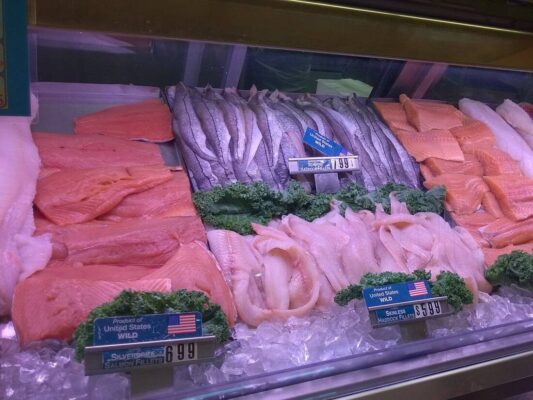
The importer’s margin is not only a service fee. It pays for the right to be wrong — and when the importer leaves, the forecast error, the slow movers and the markdown stay with the buyer.
What the evidence shows
Target’s 2022 filings document what inventory ownership cost when demand missed: stock 36% higher year on year in mid-2022 (Ecosea calculation from the company’s balance sheets), a second-quarter gross margin rate 8.9 points lower, and markdowns named among the causes. They do not price a seafood switch, and Target did not remove a distributor to produce those numbers.
Table of Contents
The short answer
When a retailer buys direct, it carries the inventory risk. The transfer happens earlier than most buyers assume: not when the pallet reaches the distribution centre, but when the purchase order becomes a commitment the factory has already scheduled. Everything after that point belongs to the retailer: the late container, the specification that sells below forecast, the promotion that does not lift, the code date that shortens in transit, and the price cut needed to clear what is left.
The importer’s margin is a bundled fee. Part of the bundle is visible: entry filing, cold storage, freight, inspection. The least itemised part is variance — the willingness to sell in small lots, hold stock across several origins and absorb the difference between the forecast and the shelf. That is not a published profit-and-loss split; it is how the service is built.
Five inventory risk items that arrive after the price
A factory price and an importer price compare on one line. The costs that decide the year sit on five other lines, and they do not arrive together.
The first arrives at the purchase order. A direct order is a production slot: minimum quantities, deposits and a month or more at sea fix the volume before the first week of sell-through reports back. An importer buying for several customers can rebalance between them; a single retailer cannot.
The next three arrive during the season. Every range has a tail that does not move at full price; every promotion is bought ahead of the event; and the direct route is the long route, so the code date on arrival is older. An importer pools the tail across accounts and turns stock closer to the port. A direct buyer pools nothing, and its own shelf-life rule forces the markdown earlier.
The last arrives after the season, as a markdown. This is where the first four become a number.
| Risk | Through the importer | Buying direct |
|---|---|---|
| Forecast error | Order sized for several customers; volume can be rebalanced between accounts. | The order is a production slot; minimums and transit fix the volume before sell-through is known. |
| Slow movers | The tail is pooled across accounts and sold in small lots. | You own your own tail, at your own code dates, in your own freezer space. |
| Promotion miss | Promoted stock is bought against several customers’ events. | The promoted stock is yours; unsold units return to the shelf at full price. |
| Short-dated stock | Turned closer to the port, so more shelf life remains on arrival. | Longest transit, oldest code date, earlier forced markdown. |
| Markdown and write-down | Absorbed by the party holding title when salability falls. | Recorded in the retailer’s own gross margin. |
What matters is where these costs land, not how large they are. They do not sit below the gross-margin line; at Target, higher clearance and promotional markdown rates and inventory impairments are reported as gross-margin pressure. A direct programme therefore does more than add work to a buying team: it moves a cost that used to sit inside the importer’s price into the retailer’s own margin, where a category manager is measured on it.
What Target’s 2022 correction documents
Target is a general-merchandise retailer, not a seafood importer, and it did not remove a distributor in 2022: it already owned this inventory. The case shows what ownership costs when demand misses, at a scale where the numbers are public.
- 2021 – mid-2022Inventory peaksStock reached $11.3 billion at 31 July 2021 and $15.3 billion at 30 July 2022.
- June 2022Rightsizing goals setThe chief executive later refers to “the inventory rightsizing goals we announced in June”.
- 17 August 2022Second-quarter resultsGross margin rate 21.5% against 30.4%; operating margin 1.2% against 9.8%; fall-season discretionary receipts cut by more than $1.5 billion.
- 28 January 2023Year endInventory $13.5 billion against $13.9 billion a year earlier; fourth-quarter discretionary inventory about 13% lower year on year.
- 28 February 2023Full-year resultsGross margin rate 23.6% against 28.3%; operating income $3.8 billion, down 57%.
In 2022, demand moved away from discretionary categories towards frequency categories while inventory was still arriving. Target’s owned brands carry longer lead times, and in the second half of the year, as port congestion eased, some stock arrived earlier than planned. The 10-K describes the response in the company’s own words: “increasing promotional and clearance markdowns, removing excess inventory, and cancelling purchase orders” (Target Corporation, 2023a).
At the end of the second quarter, inventory stood at $15.3 billion against $11.3 billion a year earlier — 36% higher (Ecosea calculation from Target’s balance sheets). Second-quarter gross margin rate fell to 21.5% from 30.4%, and operating margin to 1.2% from 9.8% (Target Corporation, 2022). The company cut fall-season discretionary receipts by more than $1.5 billion. For the full year, gross margin rate was 23.6% against 28.3%, and operating income was $3.8 billion, down 57% (Target Corporation, 2023b).
Target also names the mechanism. Owned and exclusive brands are about one third of its sales, and the 10-K notes that they “generally require longer lead times between order placement and product delivery and require us to take ownership of those products earlier in the supply chain” (Target Corporation, 2023a).
“This exposes us to enhanced risks of supply chain disruptions and changing consumer preferences.”
Ownership earlier in the chain makes the price lower and the control greater; it also puts the forecast error on the retailer’s own balance sheet.

What this does not show Target’s inventory typically turns in less than three months; frozen seafood carries a shorter usable code life, cold-chain cost and import-entry obligations, and the 2022 case contains no seafood markdown rate. Target also did not switch away from an importer to generate these numbers, so the case prices the risk of ownership, not the saving from removing a distributor. No figure here should be read as a seafood cost.
The rule: price the expected markdown
Most buyers compare expected sell-through with invoice price. That assumes the forecast is right; the question that decides the programme is what happens when it is wrong.
Price the expected markdown instead. For each SKU, the expected variance cost has three parts: the probability that full-price sell-through misses, the depth of markdown needed to clear the remainder, and the cost of holding it while you try. Multiply them, add disposal where the code date will not stretch, and compare the result with the importer’s per-unit premium. If the premium is smaller, the direct price is not cheaper. It is a bet that the forecast holds.
None of the three inputs can come from a supplier. They come from the retailer’s own clearance history for comparable specifications and from the code-date rule the buying team actually enforces. A factory’s sell-through claim is a claim about its other customers.
Then fix the transfer point in the contract. Under FOB, the retailer owns the goods once they are on board; under CIF, risk still passes at shipment even though the seller arranges freight; under DDP, the seller carries it to the named place. The Incoterm decides who owns the variance, and it is usually negotiated for freight reasons rather than risk reasons.
What to do next
- Map the transfer point. For each direct SKU, write down who owns the goods at the purchase order, at shipment, at arrival and at the shelf. If the answer changes without a signature, it is not yet a programme.
- Use your own clearance data. Three seasons of markdown depth on comparable specifications forecast variance better than any supplier’s fill-rate promise. If the data does not exist, the first direct year is the experiment that creates it.
- Keep a variance line with the importer. Leave the tail, the new origin and the promotion-sensitive SKU where the fee still buys optionality. A programme that starts with predictable volume can earn the right to take the rest.
Direct buying does not remove the importer’s margin from the system. It moves the margin’s job — absorbing variance — onto the retailer’s own profit and loss, where it is harder to see and easier to blame on the market. The retailers that do this well are not the ones with the lowest factory price; they are the ones that priced the markdown before they signed.
Before the first container
Testing a direct programme? Ecosea can help define the specification, qualify the factory and run a sample against it — so the variance you are pricing is the variance of a real product.
References
- Target Corporation. (2022, August 17). Target Corporation reports second quarter earnings [Press release]. U.S. Securities and Exchange Commission. https://www.sec.gov/Archives/edgar/data/27419/000002741922000023/a2022q2ex-99.htm
- Target Corporation. (2023a). Annual report on Form 10-K for the fiscal year ended January 28, 2023. U.S. Securities and Exchange Commission. https://www.sec.gov/Archives/edgar/data/27419/000002741923000015/tgt-20230128.htm
- Target Corporation. (2023b, February 28). Target Corporation reports fourth quarter and full-year 2022 earnings [Press release]. U.S. Securities and Exchange Commission. https://www.sec.gov/Archives/edgar/data/27419/000002741923000010/a2022q4ex-99.htm