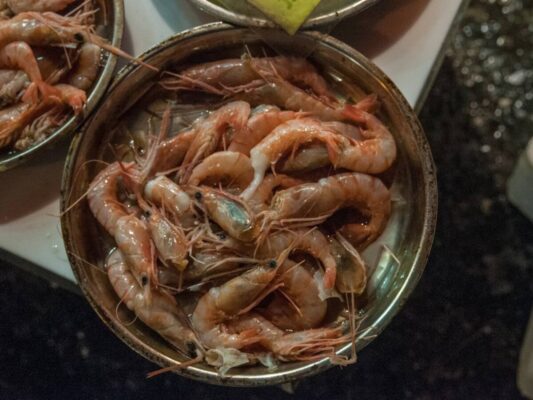
The frozen seafood shelf life validation plan belongs before the first production run, not after the first complaint. The storage condition, the tolerance and the time points are the brand’s to set, and the pack you test has to be the pack you sell.
What the evidence shows
Codex’s code of practice defines shelf life as the period in which a product keeps its safety and sensory qualities “at a specific storage temperature”, and asks for frozen storage at or colder than −18 °C with minimal fluctuation (Codex Alimentarius Commission, 2003, §§2.3, 8.1.3). The same code calls a storage fluctuation of more than 3 °C severe and sets −18 °C with a maximum fluctuation of ±3 °C for transport (§§10.3.11–10.3.12). Those are handling rules, not a product’s tolerance. The plan below is Ecosea’s proposal; the condition, the tolerance and the time points are yours to set with the pack and the customer.
Table of Contents

The frozen seafood shelf life number comes last
A shelf life is usually written into a brief as a target, then travels into the pack copy, the customer form and the launch plan before anyone has stored the product for a week.
The study produces the number; the number does not produce the study. What you decide in advance is the condition, the tolerance, the attributes, the pull points and the person who signs. What you decide afterwards is what the results allow you to claim.
Four things are being validated
Sensory. Appearance, odour, texture, flavour and cooking performance, assessed by a trained panel on a fixed cooking protocol. Codex’s fish standards cook to an internal 65 to 70 °C before sensory assessment (Codex Alimentarius Commission, 1989, §7.7); a quantitative scale, as ISO 4121:2003 describes, records intensity, and it is only comparable across sessions if its anchors are fixed.
Microbiological. Whatever your customer’s criteria require, sampled and tested by the agreed method. This part cannot be judged by looking at the product, so it is planned rather than inspected.
Physical. Freezer burn and dehydration, ice crystal growth, coating adhesion and cracking, drip loss on thaw, and pack integrity. Codex defines dehydration as moisture loss through evaporation from frozen products that are not properly glazed, packed or stored, and gives the common name for deep dehydration: freezer burn (Codex Alimentarius Commission, 2003, §2.4). Glazing is protective only when the surface is completely covered (ibid., §8.3.2).
The claim itself. A shelf life is not only a test result. It is a statement on a pack, in a market, under a customer’s policy. The study informs the statement; it does not make it.
| What is validated | How it fails | Method | Signs |
|---|---|---|---|
| Sensory | Off-odour, texture change, soggy coating, cooking time drift | Trained panel; fixed cooking to 65–70 °C; coded samples; anchored scales | Technical |
| Microbiological | Growth or a criterion breach by the declared date | The customer’s method and sample plan, stated in the protocol | QA |
| Freezer burn and dehydration | Surface drying, colour loss, tough texture | Visual and tactile check against a retained reference at each pull | Technical |
| Drip loss | Water loss on thaw; net weight shortfall | Agreed de-glazing and drain procedure; weigh before and after | Technical |
| Coating | Cracking, loss of adhesion, pickup change | Pickup as a share of finished weight; loss after fixed handling and cook | Technical, factory QC |
| Pack integrity | Leaks, seal failure, ice inside the film | Seal and leak check; visual inspection at each pull | QA |
| Claim margin | The claim fails just after the tested period | Pulls carried past the declared date | Brand, technical |
One product, one study
In one UK frozen fish range read on 1 November 2026, four coated products declare fish contents of 51%, 55%, 56% and 70%, in two coating systems: a breadcrumb and a batter. The species differ too, from cod and haddock to Alaska pollock and basa. A shelf-life result belongs to the product that was tested, at the condition it was tested under.
Codex’s shelf-life definition attaches the period to a specific storage temperature, and its guidance on storage notes that keeping time depends on the fat content of the species and the type of coating (Codex Alimentarius Commission, 2003, §10.3.11). Change the fish, glaze, coating or film, and the old result describes a different product.
The condition and the tolerance are yours
The pack instruction is a condition: store at −18 °C or colder. It is not a tolerance. A tolerance says how far the product may drift, for how long, and still be represented by the claim. That number belongs to the brand, the pack and the customer, and belongs in the protocol before the first pull.
Three practical rules follow.
Write the tolerance in the protocol, not in the meeting. “Frozen storage” is not a condition. State the set point, the permitted excursion, its duration and how many are allowed. If the answer is “none”, say so, and say what happens to the study when one occurs.
Record the instrument beside the tolerance. A logger with a stated accuracy of ±0.5 °C cannot demonstrate a tolerance narrower than its own error. Put the instrument’s accuracy and its calibration date in the protocol, and keep the raw record with the samples.
Record the life the pack actually sees. A study held in a perfect cabinet proves the product can survive a perfect cabinet. Retail storage includes door openings, defrost cycles and loading. If those are part of the claim, they belong in the condition; if not, say so.
The pack you sell
Test the retail pack, from a production run, on the line that will make it. A laboratory pouch with the same film is not the same pack: the headspace, the seal, the glaze level and the fill weight all move the result. Codex requires a glazed product’s declared net contents to exclude the glaze, and gives a de-glazing procedure for shrimp that drains for two minutes before weighing (Codex Alimentarius Commission, 1981, §§6.2, 7.3.2). If drip loss is an attribute, use that procedure, or your customer’s.
The sample that was approved is not yet the product that ships. The validation run is the first point at which the two can be compared.
The time points
Set the pulls from the declared life, and carry them past it. A study that stops at the claimed date proves the product reached the claim; it does not prove the claim has a margin. The interval is a commercial and technical decision, and it depends on the product, the pack and the customer. This article does not propose one.
At each pull, test the same attributes, with the same method, on coded samples, and record who held the samples and where. A result without its storage history is an anecdote with a date.
- Raw material or species. Fat content and texture move, and so does the rate of quality loss.
- Glaze level. Surface protection and net weight both change.
- Coating or formulation. Adhesion, colour, cook loss and allergen status can all move.
- Pack or film. Barrier, headspace and seal decide dehydration and ice growth.
- Freezer, line or process. Ice crystal size and glaze coverage follow the equipment.
- Storage site or condition. The condition written in the protocol no longer applies.
- Declared shelf life. The study bracketed the old claim, not the new one.
- Supplier site. Same specification, different plant and different handling.
What this does not show There is no typical shelf life for frozen seafood. The period depends on the species and its fat content, the glaze, the coating, the pack and its barrier, the storage condition and the customer’s policy. A number copied from another product, or from another market, is not evidence for yours. And a study that passes is not a promise that the product is good at the end of life; it is evidence at the points you tested, under the condition you recorded.
What to do next
- Write the protocol before the first production run. Condition, tolerance, attributes, methods, pull points, sample holder and signatory, on one page.
- Test the retail pack from a real run. If the pack, film or glaze is not final, the study is a pilot, not a validation.
- Put the instrument and its accuracy in the record. A tolerance that the logger cannot resolve is a claim without evidence.
- List the invalidating changes now. Pin the list beside the protocol, so a later change triggers a decision rather than a debate.
A shelf life is a promise made on a pack and kept in a cold store. The study is how you know whether you can keep it. A reformulation is a new product until its shelf life is proved again: the ingredient change is the other half of the same decision.
Ecosea works on seafood product development, specification and quality support. If a shelf-life claim is being written into a brief, the first useful step is a protocol that names the condition, the tolerance and the signatory.
Shelf-life protocol
Writing a shelf-life claim? Ecosea can draft the protocol, set the attribute list and prepare the pack for a validation run on the line that will make it.
References
- Birds Eye. (n.d.-a). 4 Cod Fillets in Breadcrumbs. Retrieved November 1, 2026, from https://www.birdseye.co.uk/range/fish/4-cod-fillets-in-breadcrumbs
- Birds Eye. (n.d.-b). 6 Chunky Fish Fingers. Retrieved November 1, 2026, from https://www.birdseye.co.uk/range/fish/6-chunky-fish-fingers
- Birds Eye. (n.d.-c). 6 Crispy Batter Chunky Fish Fingers Extra Large. Retrieved November 1, 2026, from https://www.birdseye.co.uk/range/fish/6-crispy-batter-chunky-fish-fingers-extra-large
- Birds Eye. (n.d.-d). 2 Lightly Dusted Fish Fillets with Rosemary & Sea Salt. Retrieved November 1, 2026, from https://www.birdseye.co.uk/range/fish/2-lightly-dusted-fish-fillets-rosemary-and-seasalt
- Codex Alimentarius Commission. (1981). Standard for quick frozen shrimps or prawns (CXS 92-1981, revised 1995). Food and Agriculture Organization of the United Nations; World Health Organization. https://www.fao.org/input/download/standards/107/CXS_092e.pdf
- Codex Alimentarius Commission. (1989). Standard for quick frozen fish sticks (fish fingers), fish portions and fish fillets, breaded or in batter (CXS 166-1989, revised 2004, amended 2014). Food and Agriculture Organization of the United Nations; World Health Organization. https://www.fao.org/input/download/standards/112/CXS_166e_2014.pdf
- Codex Alimentarius Commission. (2003). Code of practice for fish and fishery products (CXC 52-2003). Food and Agriculture Organization of the United Nations; World Health Organization. https://www.fao.org/input/download/standards/10273/CXP_052e.pdf
- International Organization for Standardization. (2003). Sensory analysis — Guidelines for the use of quantitative response scales (ISO 4121:2003). https://www.iso.org/standard/33817.html