
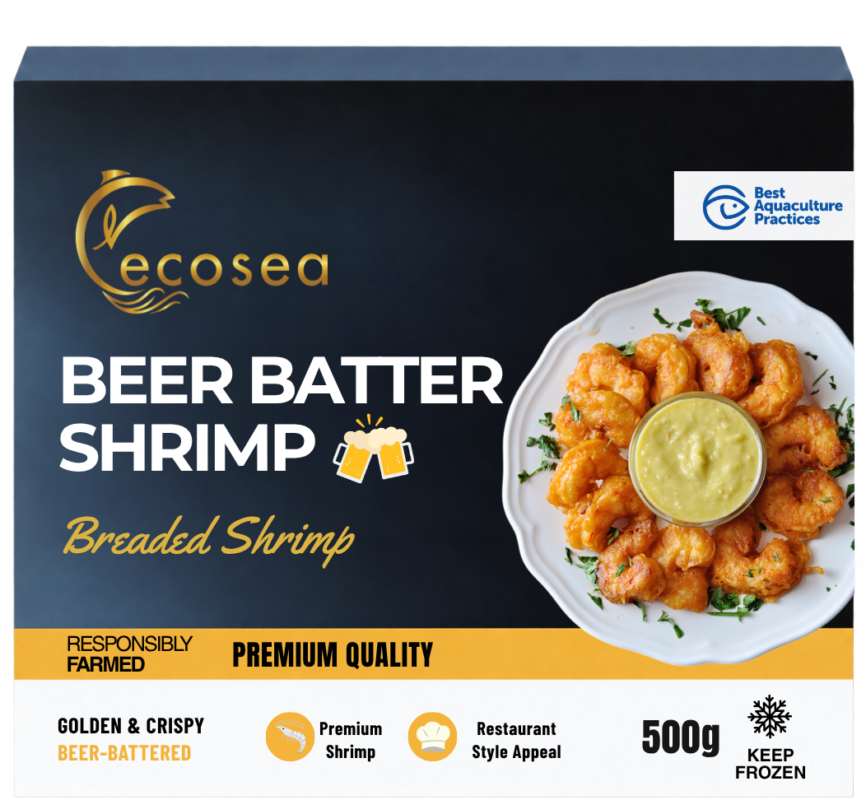
Beer Battered Shrimp
Beer-battered shrimp brings pub-style crunch to a frozen range. We develop the batter, cut and pack so you can own this format in retail or foodservice.
Tell us about your market and product requirements.
Product overview
Whole shrimp in a light, bubbly beer batter — IQF, cook-from-frozen. Appetiser, pub-style sharing plate, taco or rice-bowl topper. Retail bags to bulk foodservice (10 lb, 31–35 ct).
Applications
- Retail frozen
- Foodservice
- Party & sharing
Product information
Reference data for the displayed configuration. Confirm the final specification for your market before launch.
- Species
- Vannamei
- Cut
- Whole shrimp, tail-on (retail) or round tail-off (foodservice)
- Batter
- Wheat-flour batter made with real beer (lager or golden ale)
- Ingredients
- Shrimp, Wheat flour, Water, Beer (water, hops, rice, malted barley, corn), Vegetable oil, Modified corn starch, Salt, Sugar, Leavening (sodium acid pyrophosphate, baking soda), Spices, Paprika extract, Turmeric extract, Whey, Sodium tripolyphosphate.
- Allergens
- Shrimp (crustacean), wheat/gluten; sulphites in some recipes
- Basis
- per 100 g / per serving (85 g)
- Energy
- 241 kcal / 205 kcal
- Fat
- 13.5 g / 11.5 g
- of which saturates
- 1.8 g / 1.5 g
- of which trans
- 0 g / 0 g
- Cholesterol
- 67.6 mg / 57.5 mg
- Sodium
- 464.7 mg / 395 mg (17% DV per serving)
- Carbohydrate
- 20.6 g / 17.5 g
- of which fibre
- 1.2 g / 1 g
- of which sugars
- 1.2 g / 1 g
- Protein
- 9.4 g / 8 g
- Vitamin D
- 0 mcg / 0 mcg
- Calcium
- 105.9 mg / 90 mg
- Iron
- 0 mg / 0 mg
- Potassium
- 82.3 mg / 70 mg
- Sodium · market requirement
- Final sodium target is set per destination market. For Canada and the US, the formulation is reviewed against the applicable front-of-pack and sodium-claim thresholds before launch.
- Internal temperature
- 145–165°F (63–74°C) depending on the product — follow the pack
- Cooking
- 425–450°F, 14–19 min, turn halfway · 350°F, 2.5–3.5 min · 400°F, 8–9 min
Packaging, storage temperature and shelf life are confirmed per the agreed specification.
Options & variations
Indicative configurations for this product line. Pack format, shrimp count, coating, treatment and preparation can be specified to your brief — not every combination is standard, so confirm availability before the first sample.
| Pack format |
|
|---|---|
| Shrimp count (per lb) |
|
| Cut / shape |
|
| Coating / batter |
|
| Treatment |
|
| Sauce / seasoning |
|
| Preparation |
|
Start a sample brief
Share your benchmark, launch window, target cost and intended channel to frame the next evaluation.
Discuss your development brief ↗For product development teams
The development opportunity
An evidence-based view of why this format exists, where it sells, and what to develop. Product-line counts come from Ecosea's own market scan; market figures are from public sources, linked below.
Market rationaleWhy this format?
Beer-battered shrimp is an established multi-line format, not a niche. A scan of the category found six distinct product lines across the US and Canada, split between retail and foodservice. Retail packs span 9 oz to 1.5 lb; foodservice specs run 31-35 count/lb, including a 10 lb (4 x 2.5 lb) case. The format rests on a large shrimp base: US per-capita seafood consumption was 19.1 lb in 2023, and shrimp was the most valuable US edible seafood import at 26% of import value. Canada imported 69,070 t of shrimp in 2024 (CAD $776M), second only to salmon by value.
Where it playsChannel and occasion
Retail frozen seafood is the first arena: 9 oz to 1.5 lb bags built for oven or air-fryer preparation and sold as a pub-style appetizer or shareable plate. Foodservice is the second: 31-35 count/lb, round/tail-off product in 10 lb cases for pubs, casual dining and takeout, where count consistency and portion control decide repurchase. Canada merits its own plan: shrimp is its second-largest seafood import by value.
Product propositionWhat to differentiate?
Sodium is the clearest label-led lever: labelled sodium across the local set ranged from 200 mg to 590 mg per serving (85-112 g), about 235-694 mg per 100 g, and two lines carried 26% DV per serving. A lower-sodium batter that preserves crunch and colour is a visible point of difference. Batter credibility is the second: every line uses a beer/ale batter, so the story must go beyond "beer" - a defined ale style, a visible crumb, and tested performance under oven, air-fry and fryer reheat. Third, spec discipline: 31-35 count/lb is the foodservice benchmark, and matched retail/foodservice packs let one platform serve both channels.
References
Have an annual development brief?
Share your benchmark, launch window, target cost and intended channel to frame the next evaluation.
Related products
View all products ↗Bring this concept into your development pipeline.
Discuss formats, flavours and market requirements with our team.