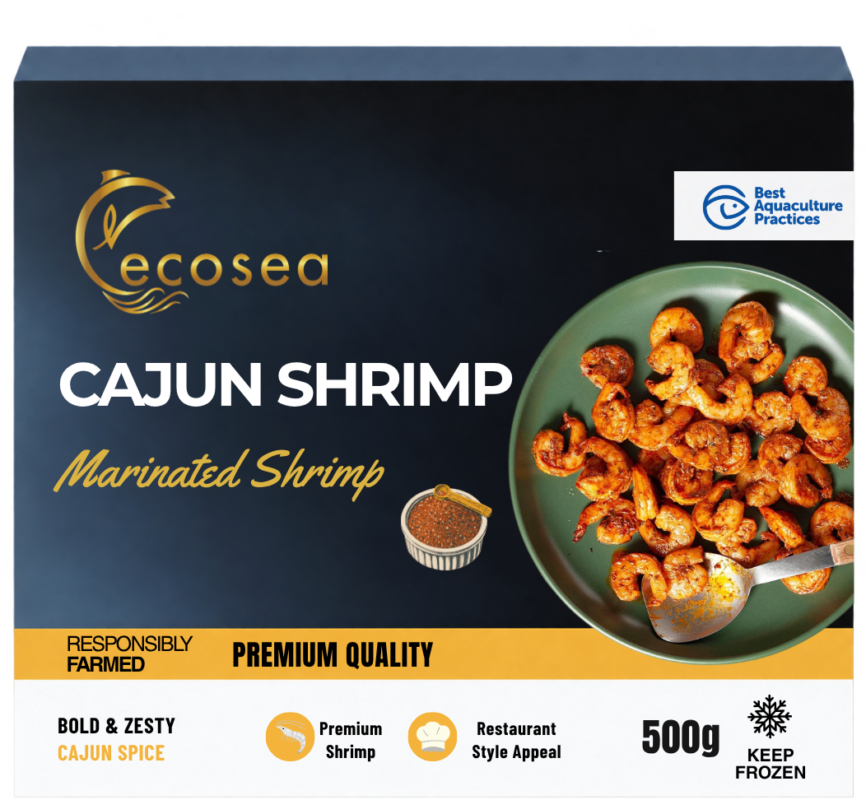
Cajun Shrimp
Cajun shrimp is a bold, sauced protein that needs no breading — a fast way to add flavour-led convenience to your range. We develop the sauce depth, heat and shrimp grade with you.
Tell us about your market and product requirements.
Product overview
Peeled shrimp in a Cajun butter sauce, frozen and ready to cook. Entrée over rice or pasta; skillet, oven or microwave. Retail sauce packs (10 oz).
Applications
- Retail frozen
- Ready to cook
- Foodservice
Product information
Reference data for the displayed configuration. Confirm the final specification for your market before launch.
- Species
- Vannamei
- Shrimp
- Peeled shrimp, sauce-packed (not breaded)
- Sauce base
- Cajun butter sauce: tomato, onion, bell pepper, paprika, garlic, spices
- Ingredients
- Shrimp, Water, Unsalted butter, Palm oil, Maltodextrin, Seasoning (paprika, tomato powder, black pepper, celery, chilli, mustard, oregano, thyme, white pepper, cayenne, garlic, onion, red bell pepper), Salt, Sugar, Rice starch, Corn starch, Lemon juice, Worcestershire sauce, Sodium tripolyphosphate.
- Allergens
- Shrimp (crustacean), milk; soy; wheat in some recipes
- Basis
- per 100 g / per serving (141 g)
- Energy
- 230 kcal / 325 kcal
- Fat
- 18.4 g / 25.9 g
- of which saturates
- 11 g / 15.5 g
- of which trans
- 0.7 g / 1 g
- Cholesterol
- 143.4 mg / 202.2 mg
- Sodium
- 509.9 mg / 719 mg (31% DV per serving)
- Carbohydrate
- 9.3 g / 13.1 g
- of which fibre
- 0.7 g / 1 g
- of which sugars
- 1.1 g / 1.6 g
- of which added sugars
- 0.7 g / 1 g
- Protein
- 7.1 g / 10 g
- Vitamin D
- 0 mcg / 0 mcg
- Calcium
- 49.6 mg / 69.9 mg
- Iron
- 0.7 mg / 1 mg
- Potassium
- 184.8 mg / 260.6 mg
- Sodium · market requirement
- Final sodium target is set per destination market. For Canada and the US, the formulation is reviewed against the applicable front-of-pack and sodium-claim thresholds before launch.
- Internal temperature
- 145°F (63°C) or 165°F (74°C) depending on the recipe — follow the pack
- Cooking
- 7–8 min (with ~1/4 cup water) · 450°F, 16–17 min · HIGH, ~5–6 min
Packaging, storage temperature and shelf life are confirmed per the agreed specification.
Options & variations
Indicative configurations for this product line. Pack format, shrimp count, coating, treatment and preparation can be specified to your brief — not every combination is standard, so confirm availability before the first sample.
| Pack format |
|
|---|---|
| Shrimp count (per lb) |
|
| Treatment |
|
| Sauce / seasoning |
|
| Preparation |
|
Start a sample brief
Share your benchmark, launch window, target cost and intended channel to frame the next evaluation.
Discuss your development brief ↗For product development teams
The development opportunity
An evidence-based view of why this format exists, where it sells, and what to develop. Product-line counts come from Ecosea's own market scan; market figures are from public sources, linked below.
Market rationaleWhy this format?
Cajun gives frozen shrimp a recognisable, heat-forward centre-of-plate role without scratch cooking. Both benchmark SKUs are frozen 10 oz / 284 g, two-serving retail packs that cook from frozen in 7-17 minutes, so the format is already positioned as a quick dinner solution rather than an ingredient. The wider context supports that positioning: US seafood consumption averaged 20.5 lb per capita in 2021, with fresh and frozen taking almost 80% of the mix (USDA ERS), while US white shrimp landings reached 107 million lb in 2024 (NOAA). In the UK, frozen seafood held 23% of retail seafood value in the 52 weeks to 4 October 2025, and frozen sauce was the fastest-growing frozen segment by volume (+19%, from a small base) (Seafish).
Where it playsChannel and occasion
US frozen seafood retail, in the two-serving dinner-for-two tier where both benchmark SKUs sit. The strongest adjacent opportunity is UK/EU multiple retail frozen sauced seafood, where the sauce segment is growing from a small base, plus foodservice and meal-solution channels where cook-from-frozen shrimp can anchor rice, grits or pasta bowls. Canada is not evidenced in the local set, so treat it as an extension rather than a proven channel.
Product propositionWhat to differentiate?
Sodium: benchmark SKUs declare 560 mg and 880 mg per 5 oz serving (25% and 38% DV), so a lower-sodium Cajun build that keeps butter richness and spice impact is a clear on-pack lever. Recipe and label: both benchmarks list sodium tripolyphosphate, and one carries starch, soy and sugar fillers; a shorter label with shrimp, butter or oil, vegetables and spices, and no added phosphate, would separate the product. Protein density and sauce load: benchmarks range from 7 g to 13 g protein per 5 oz, so shrimp-to-sauce ratio and protein per serving are meaningful quality cues.
References
Have an annual development brief?
Share your benchmark, launch window, target cost and intended channel to frame the next evaluation.
Related products
View all products ↗Bring this concept into your development pipeline.
Discuss formats, flavours and market requirements with our team.